By the dawn of the nineteenth century, the industrial revolution was radically reshaping global manufacturing, transportation, and urban society. Yet, the dissemination of news remained tethered to the physical stamina of pressmen manually pulling hand levers one sheet at a time. The burgeoning demand for daily news, driven by parliamentary debates, the Napoleonic Wars, and expanding financial markets, placed immense pressure on newspaper proprietors to break through the 300-sheet-per-hour barrier of hand-operated presses.
The solution emerged not from minor refinements to hand levers, but from the complete substitution of human muscle with steam power and the replacement of the flat platen with a revolving impression cylinder. This mechanical transformation ushered in the era of mass industrial print culture, altering the economics of publishing and making literature and journalism universally accessible to the working classes.
Friedrich Koenig and The Times Steam Cylinder Press (1814)
The breakthrough was engineered by the German inventor Friedrich Koenig alongside the precision machinist Andreas Bauer. Failing to secure financial backing in continental Europe, Koenig relocated to London, where John Walter II, proprietor of The Times, recognized the revolutionary potential of his steam-driven prototypes. Working under intense secrecy in an adjacent warehouse to prevent sabotage by Luddite pressmen, Koenig and Bauer constructed a double-cylinder steam-powered printing press.
On the historic night of November 28, 1814, John Walter entered the pressroom and announced to the assembled workers that The Times had already been printed by steam. Koenig’s press operated at an astounding 1,100 impressions per hour—nearly four times faster than the fastest hand press. In Koenig’s machine, a reciprocating bed carried the locked typographic form back and forth beneath revolving inking rollers and two continuously rotating impression cylinders, feeding paper sheets automatically.
Richard Hoe’s Lightning Rotary and William Bullock’s Continuous Web
While Koenig’s cylinder press represented an enormous leap, the reciprocating bed itself remained a mechanical liability: violently reversing the momentum of hundreds of pounds of metal type at high speeds created severe mechanical strain. The next leap required eliminating reciprocating motion entirely by locking the type onto a revolving cylinder.
In 1844 in New York, Richard March Hoe patented the Type Revolving Press (popularly dubbed the ‘Lightning Press’). Hoe devised wedge-shaped cast-iron beds called ‘turtles’ with tapered brass column rules that clamped movable lead type securely onto the circumference of a giant central cylinder. Surrounding this central type drum were multiple smaller impression cylinders (eventually scaling to ten feeders), achieving speeds of up to 20,000 impressions per hour for the New York Tribune and Philadelphia Public Ledger.
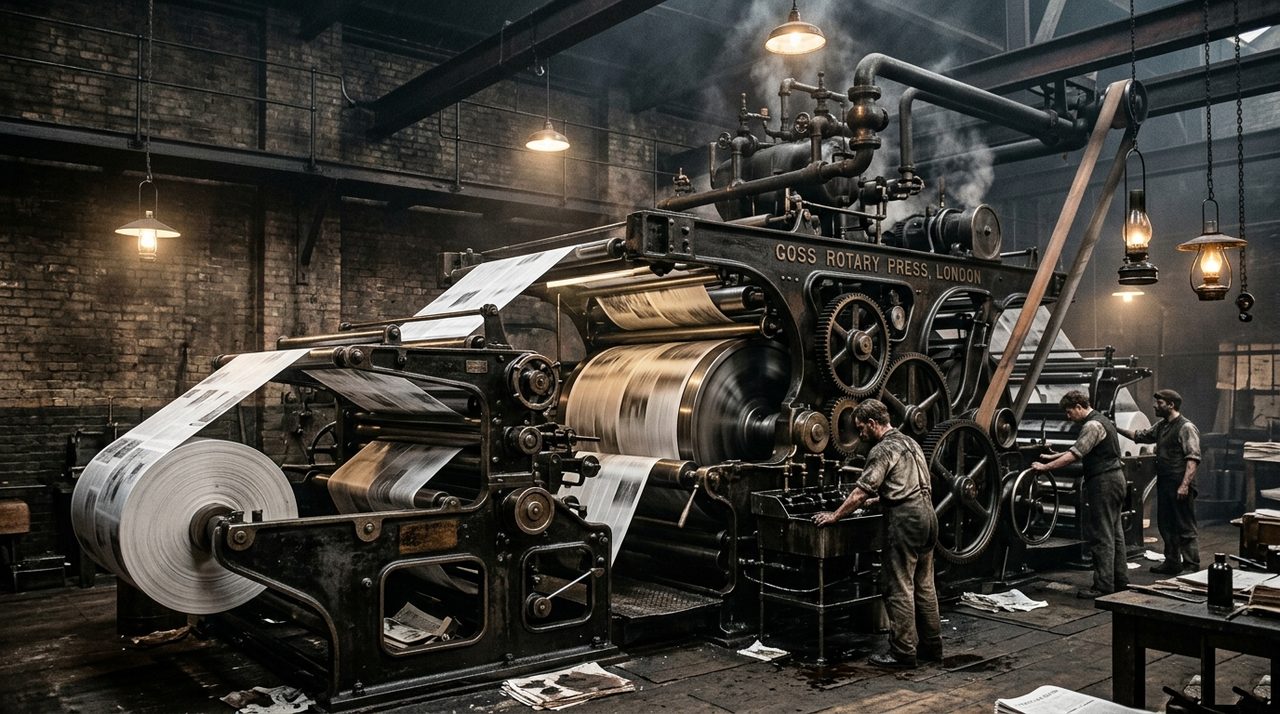
The final constraint of hand-feeding individual pre-cut sheets of paper was shattered in 1865 by William Bullock. Bullock engineered the first web-fed rotary perfecting press. Utilizing continuous paper reels manufactured from wood pulp and curved stereotype plates cast from papier-mâché flong matrices, Bullock’s press printed both sides of the sheet simultaneously (‘perfecting’) and automatically folded and cut the finished newspapers, establishing the engineering blueprint for modern 20th-century mass printing.
Rotational Dynamics and Angular Velocity in Cylinder Printing
The physical breakthrough of Friedrich Koenig’s cylinder press and Richard Hoe’s rotary press lay in transitioning from intermittent reciprocating linear motion to continuous rotational dynamics. In a flatbed press, the entire mass of the bed (often exceeding 500 kg of cast iron and lead type) must be accelerated from a standstill, brought to peak velocity, brought to a dead stop, and reversed in direction twice per impression cycle.
Newton’s second law of motion (Force = Mass × Acceleration) dictates that as press speed doubles, the inertial shock forces exerted on reversing gears and drive linkages increase exponentially. Koenig minimized this by using continuously rotating impression cylinders. Richard Hoe eliminated reciprocating bed momentum entirely by mounting type directly onto a rotating central drum. The tangential surface speed of Hoe’s lightning press cylinder reached over 3.5 meters per second, requiring specialized mechanical clamps to prevent centrifugal force from flinging lead type across the pressroom.
Continuous Web Paper Physics: Tensile Strength and Moisture Control
William Bullock’s web-fed rotary press demanded continuous reels of paper rather than pre-cut sheets. This required paper mills to transition from short rag fibers to long-fiber chemical wood pulp (kraft process). In a web press operating at 12,000 impressions per hour, the continuous paper web experiences tremendous dynamic tensile stresses, reaching speeds of 300 to 500 meters per minute.
If the web tension fluctuates by even a fraction of a percent, the paper stretches unevenly, causing catastrophic web breaks that snap the paper reel and shut down the press line. Bullock engineered pneumatic brake drums and floating tension dancer rollers that dynamically absorbed mechanical vibrations. Furthermore, paper rolls were maintained at strict 50% relative humidity: dry paper became brittle and suffered electrostatic cling, while damp paper experienced moisture expansion that threw four-color registration out of alignment.
Archival Standards, Metallurgy Conservation, and Incunabula Preservation
The material preservation of historical printing machinery, movable lead matrices, and early incunabula imprints is governed by strict international conservation protocols codified by the International Council of Museums (ICOM-CC) and the Library of Congress Preservation Directorate. Incunabula printed prior to 1501 demand specialized environmental controls to halt physical and chemical decay:
When conserving early letterpress imprints, conservators never use synthetic tape or non-reversible modern adhesives. Any tears in incunabula leaves are repaired exclusively with pure Japanese kozo tissue (mulberry fibers) adhered with reversible, purified wheat starch paste (pH 7.0), ensuring that any physical conservation treatment can be safely reversed by future conservators without damaging the original printing artifact.
Frequently Asked Questions on Printing History and Mechanics
Why did Gutenberg’s movable type printing succeed commercially where earlier Asian systems remained localized?
While movable ceramic type (China) and cast bronze type (Korea) predated Gutenberg by centuries, their widespread commercial adoption was hindered by linguistic and metallurgical factors. Chinese and Korean scripts require thousands of distinct ideographic characters, making manual type founding, storage cases, and sorting logistically demanding. The Latin alphabet, conversely, requires only 26 alphabetic characters plus punctuation and ligatures (around 150 to 200 sorts total). Gutenberg coupled this alphabetic simplicity with an integrated industrial manufacturing system: the adjustable handheld casting mold for casting identical type shanks, an oil-based printing ink that adhered to metal, and the wooden screw press.
What is the mechanical difference between a ‘one-pull’ and ‘two-pull’ hand press?
On a common wooden press, the platen was only half the size of the press bed because the wooden frame could not withstand the compressive tonnage required to print an entire sheet at once without flexing. The pressman pulled the lever to print the first half of the sheet, cranked the rounce handle to advance the bed, and pulled the lever a second time to print the second half (‘two pulls’). The 1800 Stanhope cast-iron press, with its rigid frame and compound toggle levers, exerted double the force, allowing an entire folio sheet to be printed across its full surface in a single pull (‘one pull’).
How did curved stereotype plates enable high-speed rotary printing?
Locking thousands of individual, loose lead types directly onto a rapidly revolving cylinder was dangerous: centrifugal force inevitably loosened column rules and threw type out of the press. Stereotyping solved this by creating a single, solid, curved metal replica of an entire newspaper page. A flexible papier-mâché ‘flong’ was beaten into the flat type form to create a heat-resistant matrix, which was placed into a semi-cylindrical casting box. Molten lead was poured inside, casting a rigid, curved metal plate that clamped securely onto the rotary press cylinder.
Why did the Linotype machine replace manual typesetting in newspapers but not in fine bookwork?
The Linotype machine cast an entire line of text as a single solid lead bar (‘slug’). While this revolutionized newspaper production by allowing a compositor to set 8,000 characters an hour, it made editorial corrections difficult: if a single typo occurred, the entire slug had to be re-typed and re-cast. The Monotype system, which cast individual, separate pieces of type from a pneumatic paper tape, allowed proofreaders to correct single letters with tweezers, making it the preferred choice for fine book publishers, complex mathematical tables, and scholarly editions.
The Rise of the Penny Press and Mass Public Journalism
The explosive production velocities achieved by Koenig’s steam cylinder press and Hoe’s lightning rotary completely restructured the economics of journalism, giving birth to the Penny Press phenomenon of the 1830s and 1840s. Prior to steam printing, newspapers were expensive six-cent broadsheets catering exclusively to wealthy mercantile and political subscribers, typically filled with dry shipping manifests and partisan political speeches.
By slashing unit manufacturing costs to fractions of a cent, rotary presses enabled publishers like Benjamin Day (The New York Sun) and James Gordon Bennett (The New York Herald) to sell daily papers for a single penny. This pricing democratization transformed the newspaper into an everyday necessity for millions of working-class citizens. To satisfy this vast, newly literate audience, reporting pivoted from elite political dispatches toward investigative local crime reporting, human-interest features, sensational exposés, and accessible public education. The steam press became the primary engine forging modern democratic civic consciousness.
Modern Industrial Rotaries and Environmental Web Press Chemistry
The mechanical principles pioneered by William Bullock’s continuous web press remain the foundation of contemporary commercial publication printing. Modern commercial web offset presses, such as the Goss Sunday or Heidelberg Harris lines, operate continuous paper webs traveling at speeds exceeding 15 meters per second (over 30 miles per hour), printing, drying, and folding sixty-four full-color magazine pages in a fraction of a second.
To operate responsibly at this colossal scale, modern industrial pressrooms have undergone an environmental revolution: replacing petroleum-based inks with rapidly renewable soy and vegetable formulations, utilizing high-velocity hot-air drying ovens equipped with regenerative thermal oxidizers (RTOs) that incinerate volatile organic compounds (VOCs) with 99% thermal efficiency, and recycling 100% of paper trim waste back into de-inked pulp mills, bridging industrial scale with ecological stewardship.