THE EDITORIAL DESK · PUBLISHING & WRITING
From First Draft to Final Publication
Understand how different editorial stages improve a manuscript’s structure, language, accuracy, and presentation before readers see the finished work.
Publishing a book, article, report, or magazine feature involves much more than writing a first draft.
Even experienced writers need time to review their work, improve clarity, correct inconsistencies, and prepare the text for readers.
That is why professional publishing uses several editorial stages.
Three of the most important are editing, copyediting, and proofreading.
These terms are sometimes used interchangeably in everyday conversation, but they describe different kinds of work.
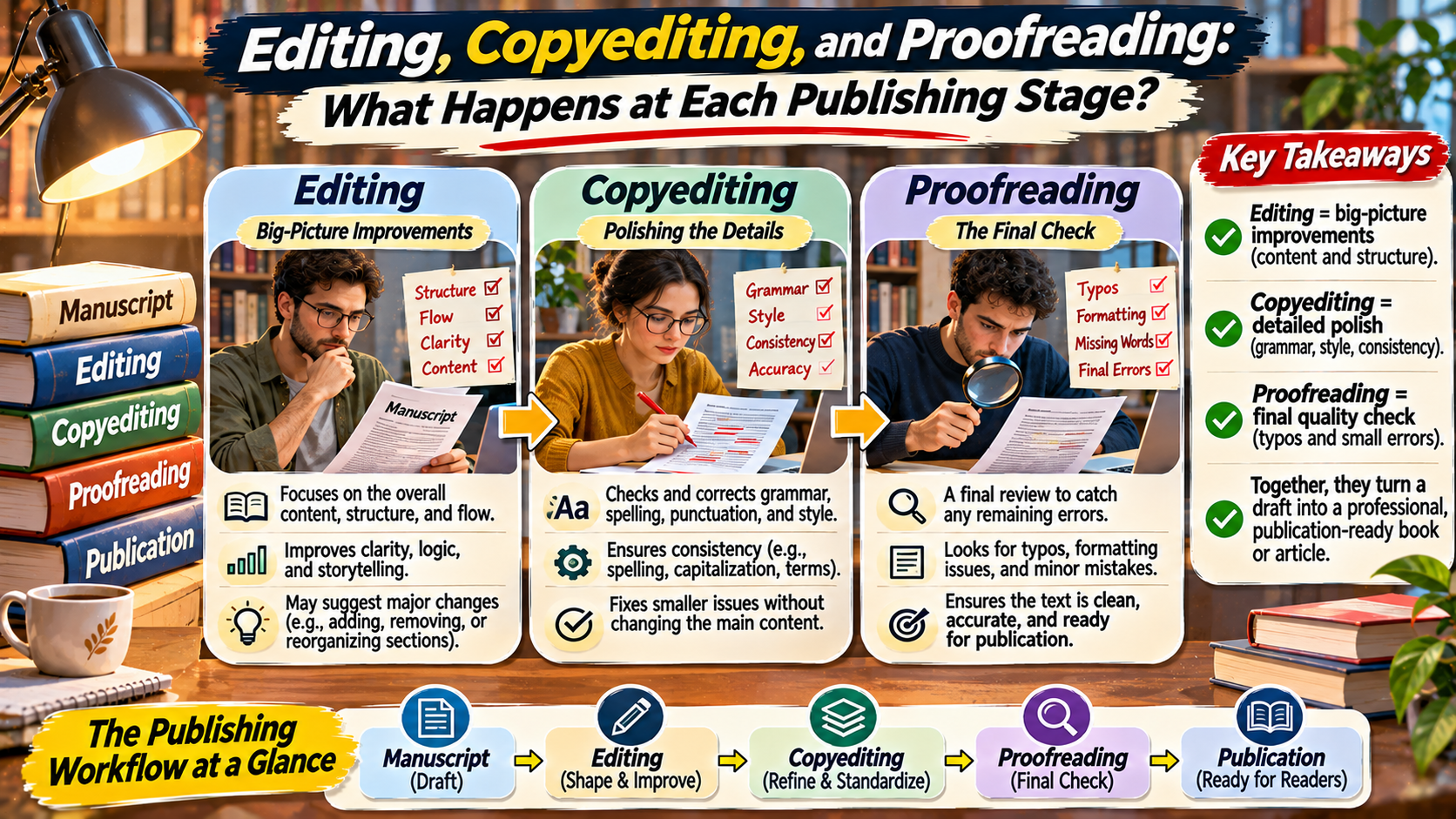
Editing often focuses on the content and structure of a manuscript.
Copyediting concentrates on language, consistency, and correctness.
Proofreading checks the nearly finished publication for remaining errors.
Each stage answers a different question: Does the content work? Is the language correct and consistent? Is the final version ready to publish?
Understanding these differences helps authors, bloggers, students, businesses, and publishing teams produce clearer and more reliable material.
Why Publishing Uses Multiple Editorial Stages
A manuscript can contain several different types of problems.
Some affect the overall message.
Others involve grammar, punctuation, terminology, or formatting.
A document may be grammatically correct but poorly organized.
It may have an excellent structure but contain inconsistent spelling or unclear sentences.
Even after these problems are corrected, mistakes can appear during layout and formatting.
Using separate editorial stages allows each type of issue to receive appropriate attention.
The process also reduces the risk of spending time polishing sentences that may later be removed during major revisions.
Not every publication follows exactly the same workflow.
Small teams may combine responsibilities, while traditional publishers may employ specialists for different stages.
Nevertheless, the underlying goals remain similar.
Stage 1: Editing Improves the Content
Editing is a broad term that can include several levels of manuscript review.
At its most substantial, editing examines the ideas, organization, argument, narrative, and overall effectiveness of the writing.
For a nonfiction article, an editor may ask whether the introduction clearly establishes the topic.
They may examine whether each section contributes useful information.
They may also identify unsupported claims, repeated explanations, missing context, or confusing transitions.
For a novel, editing may involve plot development, character motivation, pacing, and narrative consistency.
The goal is not simply to remove mistakes.
It is to improve how successfully the manuscript communicates with its intended audience.
Developmental Editing
Developmental editing focuses on the larger structure and purpose of a manuscript.
It may involve reorganizing chapters, recommending new sections, identifying missing information, or suggesting substantial revisions.
A developmental editor might notice that a guide explains advanced concepts before introducing the basics.
They could recommend changing the order to make the material easier for beginners to understand.
Line Editing
Line editing works more closely with individual paragraphs and sentences.
It focuses on clarity, flow, rhythm, tone, and expression.
A line editor may simplify an awkward sentence or improve a transition between ideas.
The aim is to strengthen the writing while preserving the author’s intended meaning and voice.
Some publishing workflows treat line editing as a separate stage, while others include it within broader editing services.
EDITORIAL PRINCIPLE / FIRST REVIEW
Fix the Structure Before Polishing Every Sentence.
Major editorial revisions can remove, combine, or rewrite entire sections. Detailed language corrections are usually more efficient after the manuscript’s content has stabilized.
What Does an Editor Actually Check?
An editor’s responsibilities depend on the publication and the level of editing requested.
Common areas of attention include the manuscript’s central purpose, intended readership, organization, and completeness.
Editors may examine whether the information is presented in a logical order.
They may recommend cutting repetitive passages or expanding explanations that lack sufficient detail.
In instructional writing, they may check whether the steps are understandable and correctly sequenced.
In academic or technical writing, editors may identify areas that need stronger evidence or clearer definitions.
However, editing does not automatically include independent fact-checking.
Fact-checking may be a separate responsibility, and its scope should be agreed upon before work begins.
Stage 2: Copyediting Improves Correctness and Consistency
Once the manuscript’s structure and content are reasonably settled, copyediting focuses on the details of the text.
A copyeditor reviews grammar, spelling, punctuation, syntax, and usage.
They also check consistency across the document.
For example, a manuscript might use “email” in one chapter and “e-mail” in another.
It may spell a person’s name differently in separate sections.
Dates, numbers, abbreviations, capitalization, and terminology may also vary.
Copyediting helps establish a consistent approach.
Professional copyeditors often follow an established style guide or a publication’s internal editorial standards.
Examples include The Chicago Manual of Style, the Associated Press Stylebook, and organization-specific style guides.
The appropriate guide depends on the type of publication and its audience.
Common Tasks Performed During Copyediting
Copyediting involves more than correcting obvious spelling mistakes.
A copyeditor may review sentence structure to eliminate grammatical ambiguity.
They may standardize headings and ensure terminology is used consistently.
They may check that references to figures, tables, or chapters match the surrounding text.
Depending on the agreed scope, they may flag questionable factual statements or verify selected details.
Copyeditors may also identify missing citations or inconsistencies in reference formatting.
However, a standard copyedit is not necessarily a comprehensive research review.
The work should be defined clearly so that authors understand what is included.
Example: A Sentence Before and After Copyediting
BEFORE COPYEDITING
“The company have published it’s annual reports on monday, and the results was positive.”
AFTER COPYEDITING
“The company published its annual report on Monday, and the results were positive.”
The revised version corrects agreement, capitalization, possessive usage, and wording.
A copyeditor would also confirm whether the author intended a singular report or multiple reports before making that change in a real manuscript.
This illustrates an important principle: editorial corrections should preserve the author’s intended meaning.
What Is an Editorial Style Sheet?
A style sheet is a document used to record editorial decisions and maintain consistency.
It may include preferred spellings, capitalization rules, terminology, abbreviations, and formatting conventions.
For a book, the style sheet might record character names, place names, and recurring technical terms.
For a business report, it may specify how dates, currencies, percentages, and job titles should appear.
Style sheets are especially useful for long manuscripts or projects involving several contributors.
They help ensure that later revisions follow the same decisions made during copyediting.
A proofreader may also consult the style sheet when reviewing the final pages.
Stage 3: Proofreading Checks the Final Version
Proofreading is usually one of the last editorial stages before publication.
Its primary purpose is to identify errors that remain after editing and copyediting.
In traditional book publishing, proofreading takes place after the manuscript has been typeset or laid out into pages.
The proofreader examines the near-final version rather than an early draft.
This matters because new problems can appear during production.
A heading might be missing, a line could break awkwardly, or a correction might have been entered incorrectly.
Proofreading focuses on catching these issues without introducing unnecessary new revisions.
Major structural changes at this stage can be expensive and may create additional errors.
What Does a Proofreader Look For?
A proofreader checks the final text for remaining typographical and presentation errors.
These may include misspelled words, missing punctuation, repeated words, or incorrect capitalization.
In a formatted publication, the proofreader may also identify inconsistent headings, page-number problems, incorrect running headers, or unusual spacing.
They may check whether captions, tables, and other elements appear where expected.
For digital publications, proofreading may involve reviewing the final web page or ebook presentation.
Broken formatting, missing text, and incorrectly displayed characters may need attention.
The exact responsibilities depend on the production process.
Proofreading is not intended to replace developmental editing or a thorough copyedit.
Editing vs. Copyediting vs. Proofreading: Key Differences
| Feature | Editing | Copyediting | Proofreading |
|---|---|---|---|
| Main purpose | Improve content and structure | Correct language and consistency | Catch final errors |
| Typical timing | Early revision stage | After major revisions | Near publication |
| Primary focus | Ideas, organization, clarity | Grammar, usage, style | Typos, layout, presentation |
| Changes allowed | May be substantial | Usually sentence-level | Usually minimal |
| Typical output | Revised manuscript or editorial feedback | Corrected, consistent text | Final correction list or marked proofs |
The Complete Publishing Workflow
Although publishers organize their work differently, a common editorial sequence follows several stages.
The writer first develops a draft.
Major revisions address content, structure, and overall effectiveness.
Once the manuscript is stable, copyediting improves language and consistency.
The corrected manuscript then moves into design, formatting, or typesetting.
Proofreading checks the near-final version.
After approved corrections are entered and verified, the publication can be released.
PUBLISHING PRODUCTION / EDITORIAL SEQUENCE
The author develops the initial content.
The structure, ideas, flow, and clarity are improved.
Grammar, punctuation, terminology, and consistency are reviewed.
The manuscript is prepared in its intended publication format.
Remaining textual and presentation errors are identified.
Corrections are checked and the finished work is released.
How the Process Works for Books
Book publishing often involves several editorial specialists.
A developmental editor may review the manuscript’s structure and overall effectiveness.
The author then completes major revisions.
A copyeditor reviews the revised manuscript for correctness and consistency.
After copyediting, the text is prepared for typesetting and page design.
A proofreader checks the resulting pages.
The publisher may also review cover copy, contents pages, indexes, and other supporting material.
Because books are long and complex, maintaining consistent editorial decisions is particularly important.
However, the exact workflow varies between traditional publishing, independent publishing, and academic publishing.
How the Process Works for Websites and Blogs
Digital publishing often follows a faster editorial cycle than traditional book production.
A blog article may begin with research and drafting.
An editor then checks whether the article answers the intended reader’s questions.
Copyediting improves sentence clarity, grammar, and consistency.
The article is then formatted for the website.
Headings, images, captions, links, and other elements are added.
Proofreading should ideally occur after the article is displayed in its final publishing environment.
This allows the reviewer to identify problems that may not appear in the original document.
Examples include broken headings, missing paragraphs, incorrect image captions, and formatting inconsistencies.
For websites, checking factual accuracy and links is also valuable, although these tasks should be assigned explicitly rather than assumed to be part of basic proofreading.
Why Authors Should Not Skip Editing
Writers often become familiar with their own words after spending many hours drafting and revising.
This familiarity can make certain problems harder to notice.
An author may understand an explanation because they already know the subject, while a new reader finds it confusing.
Repeated sentences may seem necessary during drafting but unnecessary during revision.
A separate editorial review introduces another perspective.
It can reveal unclear assumptions, weak transitions, and gaps in information.
Even when a professional editor is unavailable, writers can improve their work by allowing time between drafting and revision.
Reading aloud, reviewing an outline, and asking a knowledgeable reader for feedback can help identify issues.
These methods do not replace every professional service, but they can improve the quality of a manuscript.
Can One Person Perform All Three Stages?
Yes. In small publishing teams, one person may handle editing, copyediting, and proofreading.
Freelance editors may also offer multiple services.
However, it is useful to separate the stages mentally and practically.
Trying to evaluate structure, grammar, and final formatting at the same time can divide attention.
A more systematic approach is to review the manuscript in several passes.
First, examine the content and organization.
Next, focus on language and consistency.
Finally, check the publication-ready version for remaining mistakes.
Even when the same person performs every review, this sequence helps maintain a clear purpose for each pass.
Can AI Tools Replace Editors and Proofreaders?
Digital writing tools can assist with spelling, grammar, and sentence suggestions.
Some can also identify repetitive wording or propose structural changes.
These features may help writers review their drafts more efficiently.
However, automated suggestions can be incorrect or inappropriate for the intended audience.
A tool may alter the meaning of a sentence while attempting to simplify it.
It may also overlook factual problems, context, or specialized terminology.
For this reason, human judgment remains important.
Writers and editors should review automated changes rather than accepting them without consideration.
Editorial responsibility ultimately includes protecting the accuracy, clarity, and intended meaning of the published work.
How to Choose the Right Editorial Service
The appropriate service depends on the manuscript’s condition.
If the overall structure is weak, developmental or substantive editing may be the best starting point.
If the content is strong but the writing feels awkward, line editing may help.
If the manuscript is ready in substance but contains grammar and consistency issues, copyediting is usually appropriate.
If the final formatted document needs one last review, proofreading is the relevant stage.
Before hiring an editor, clarify the intended audience, publication format, deadline, and scope of work.
It is also useful to ask whether fact-checking, reference checks, and formatting reviews are included.
Clear expectations help avoid misunderstandings about what the service will deliver.
Frequently Asked Questions
What is the main difference between editing and proofreading?
Editing improves the manuscript’s content, structure, or expression. Proofreading checks the near-final publication for remaining errors.
Is copyediting the same as proofreading?
No. Copyediting focuses on language correctness and consistency before final production, while proofreading checks the publication-ready version.
Which stage comes first?
Major editing and revision usually come first, followed by copyediting and then proofreading.
Does copyediting include fact-checking?
Some copyediting services include limited factual queries or verification, but comprehensive fact-checking is often a separate task.
Can proofreading fix a badly written manuscript?
Proofreading can correct remaining surface errors, but it is not designed to solve major structural or clarity problems.
Do blog articles need proofreading?
Yes. A final review can catch typos, missing text, formatting errors, and other problems before publication.
Can one editor handle every stage?
Yes, especially on smaller projects, but separating the work into distinct passes helps maintain focus.
Final Thoughts
Editing, copyediting, and proofreading are related but distinct parts of the publishing process.
Editing strengthens the manuscript’s ideas, structure, and effectiveness.
Copyediting improves grammar, usage, terminology, and consistency.
Proofreading checks the final presentation for remaining mistakes.
Each stage contributes to a different aspect of publication quality.
Skipping a stage can leave problems that another type of review is not intended to solve.
Whether preparing a book, article, academic paper, or website, understanding these editorial responsibilities helps writers plan revisions more effectively.
The strongest publishing workflows treat quality as a process rather than a single final check.
When content, language, and presentation are reviewed in the right order, the finished work becomes clearer, more consistent, and easier for readers to trust.