THE MANUSCRIPT COLLECTION / HISTORY OF BOOKS & WRITING
When Every Book Was Made by Hand
Discover how scribes copied texts, artists decorated manuscripts, and communities preserved and exchanged knowledge long before mechanical printing transformed book production.
Today, books can be printed in enormous quantities, downloaded in seconds, or read on electronic devices.
For much of human history, however, producing a book required a very different process.
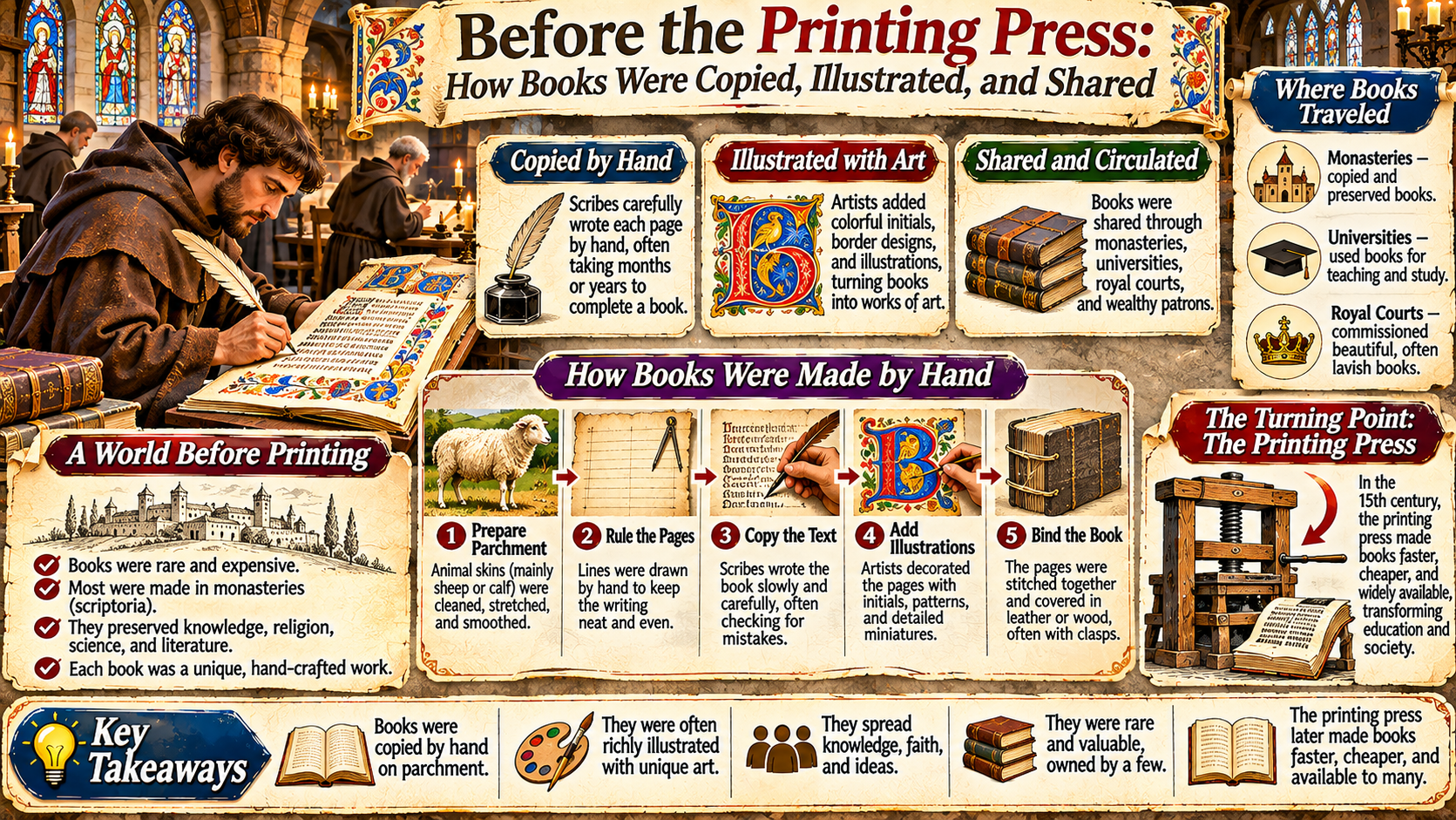
Before mechanical printing became widespread, many books were copied by hand.
Creating a manuscript could involve preparing writing materials, carefully reproducing text, adding illustrations, and binding individual pages into a finished volume.
The work demanded time, skill, and resources.
In medieval Europe, scribes working in religious institutions, universities, and commercial workshops played important roles in preserving written knowledge.
Elsewhere, manuscript traditions flourished in Islamic societies, South Asia, East Asia, and other regions.
Although the methods varied, these cultures developed sophisticated systems for producing and circulating written works.
Understanding how books were made before the printing press reveals why manuscripts were valuable and how knowledge traveled across generations.
What Was a Manuscript?
A manuscript is a document written by hand rather than produced through mechanical typesetting.
Manuscripts existed in many forms, including religious texts, legal records, scientific works, literature, and historical chronicles.
Some were simple documents intended for practical use.
Others were elaborate books containing decorated letters, illustrations, and expensive materials.
Manuscripts could be written on papyrus, parchment, paper, or other suitable surfaces.
The materials depended on geographic location, historical period, and local resources.
In medieval Europe, parchment and vellum were commonly used for important books.
Paper became increasingly important in Europe during the later Middle Ages, although it had been developed and used much earlier in China.
How Writing Materials Were Prepared
Before a scribe could begin copying a book, suitable writing surfaces had to be prepared.
Parchment was commonly made from processed animal skin.
The skin was cleaned, stretched, scraped, and dried to create a surface suitable for writing.
Preparing parchment required specialized labor and materials.
Large manuscripts could require substantial quantities of prepared skin.
Paper offered a different writing surface and became increasingly important as production and trade expanded.
Scribes also needed ink and writing tools.
Quill pens made from bird feathers were widely used in medieval Europe.
Ink recipes varied, but iron gall ink became especially important for many historical manuscripts.
The quality of the materials influenced the appearance and durability of the finished book.
The Work of Medieval Scribes
A scribe was a person trained to reproduce written texts.
Copying a manuscript required concentration and familiarity with writing conventions.
The scribe typically worked from an existing text, sometimes called an exemplar.
Letters were written individually, line by line.
Pages might be ruled in advance to guide the placement of text.
Depending on the manuscript, scribes used different scripts and page layouts.
Some manuscripts included wide margins for notes, corrections, or decoration.
Errors could occur during copying.
Scribes sometimes omitted words, repeated passages, or introduced other changes.
Corrections might be added by the original scribe or another reader.
Because copying was a human process, surviving versions of the same work sometimes contain textual differences.
Scriptoria: Places Where Manuscripts Were Copied
In some medieval monasteries, manuscript production took place in designated writing spaces often described as scriptoria.
Religious communities copied biblical texts, theological works, and other materials.
Monasteries were important centers of manuscript preservation, but they were not the only places where books were produced.
As European towns and universities expanded, professional scribes and commercial book workshops became increasingly important.
University communities needed copies of textbooks and scholarly works.
Legal professionals, administrators, and wealthy patrons also commissioned manuscripts.
These demands encouraged specialized production and commercial exchange.
HISTORICAL NOTE / MANUSCRIPT PRODUCTION
Not Every Medieval Book Was Produced in a Monastery.
Commercial workshops, universities, courts, and private patrons also contributed to the production and circulation of handwritten books.
How Manuscripts Were Illustrated
Some manuscripts contained illustrations that helped explain the text or enhance the book’s appearance.
These images could depict religious scenes, historical events, plants, animals, scientific subjects, or everyday activities.
Artists used pigments prepared from minerals, plants, and other materials.
Colors were applied carefully to the writing surface.
Some luxurious manuscripts included gold leaf or other metallic decoration.
Such decorated books are often called illuminated manuscripts.
The term illumination is particularly associated with the visual brilliance created by gold and other decorative elements.
Illustrations were not merely ornamental.
They could help readers understand complex ideas, identify important sections, or follow a narrative.
In scientific and medical manuscripts, diagrams and images sometimes communicated information that was difficult to explain through words alone.
Decorated Initials and Page Design
One recognizable feature of many medieval manuscripts is the decorated initial letter.
These enlarged letters often marked the beginning of an important passage.
Some were filled with geometric patterns, plants, animals, or human figures.
Others included elaborate scenes extending into the surrounding margins.
Page design helped organize information.
Rubrication, the use of red writing or markings, could identify headings, instructions, or important passages.
Marginal notes allowed readers to add explanations or comments.
These features demonstrate that manuscript makers considered both the appearance and practical usability of their books.
From Loose Pages to a Bound Book
After the text and decoration were completed, manuscript pages needed to be assembled.
In many European codices, sheets were folded into groups called gatherings or quires.
These gatherings were arranged in the correct order.
They could then be sewn together to create the book’s structure.
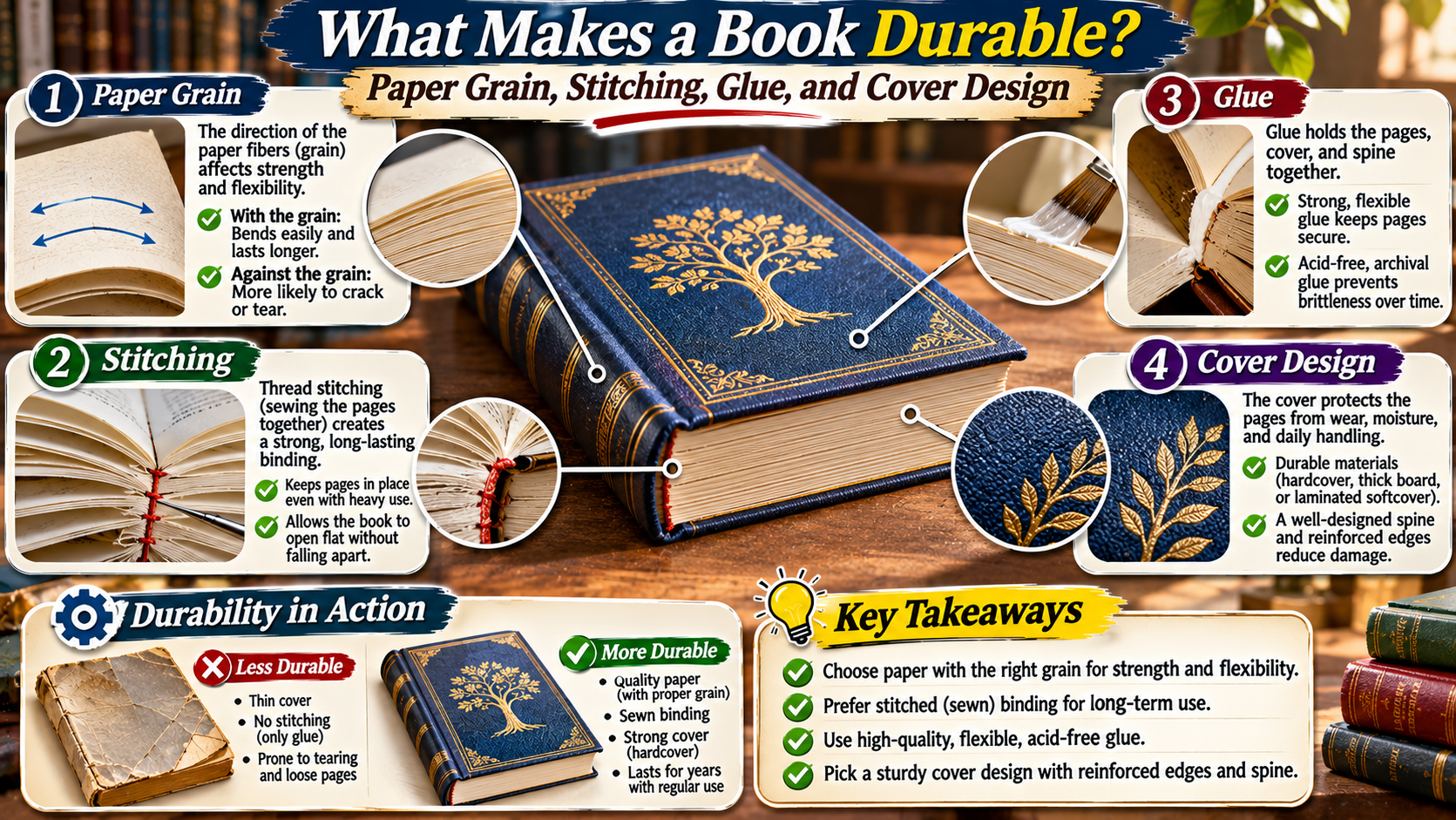
Book covers helped protect the pages.
Bindings varied from relatively simple constructions to elaborate covers made with wood, leather, metal fittings, or decorative materials.
Binding was a skilled craft.
A durable binding made a manuscript easier to handle, store, and transport.
The Manuscript-Making Process
BOOKMAKING WORKSHOP / PRODUCTION STAGES
Parchment or paper is prepared and organized for the planned manuscript.
Margins, writing lines, and spaces for illustrations are established.
A scribe reproduces the manuscript carefully from an existing source.
Artists may add initials, illustrations, pigments, or gold decoration.
Pages are organized, sewn, and protected within a finished binding.
How Long Did It Take to Copy a Book?
The time required to copy a manuscript depended on its length, script, materials, and decoration.
A short, simple text could be completed much more quickly than a large illustrated volume.
Complex manuscripts might involve several specialists.
A scribe could copy the text while artists and binders completed other stages.
Some projects took months or longer, although there was no universal production time.
The cost of materials and labor meant that elaborate books could be expensive.
This limited access for many people, particularly when compared with later mass-produced printed books.
How Books Were Shared Before Printing
Handwritten books circulated through several channels.
Religious institutions maintained collections for worship, study, and preservation.
Universities needed texts for teaching and scholarship.
Wealthy individuals commissioned or acquired manuscripts for private libraries.
Books could also be exchanged, donated, inherited, or sold.
Some university book systems allowed portions of approved texts to be copied by different scribes, helping increase access to important works.
Traveling scholars, merchants, and religious communities contributed to the movement of manuscripts between regions.
These networks helped written knowledge spread despite the slow pace of manual copying.
Manuscript Traditions Beyond Medieval Europe
Handwritten book production was not limited to European monasteries.
Islamic societies developed extensive manuscript cultures involving literature, theology, medicine, mathematics, astronomy, and other subjects.
Calligraphy and manuscript decoration became highly developed artistic traditions.
In South Asia, texts were copied onto materials including palm leaves and paper.
East Asian cultures also maintained rich traditions of handwritten documents and books.
Importantly, printing technologies existed in East Asia long before Gutenberg’s press became influential in Europe.
Woodblock printing was used in China centuries earlier, and movable-type methods also developed in East Asia.
Therefore, the history of book production cannot be described as a simple worldwide transition from handwriting directly to Gutenberg’s invention.
Different societies used different technologies and materials over time.
Manuscripts vs. Printed Books
| Feature | Handwritten Manuscripts | Printed Books |
|---|---|---|
| Production | Text copied individually by hand | Multiple copies produced using printing methods |
| Speed | Often slow and labor-intensive | Generally faster for repeated copies |
| Variation | Copies may contain individual differences | Copies from the same edition are usually more consistent |
| Decoration | May include individually painted illustrations | Images can be reproduced using printing techniques |
| Availability | Often limited by production time and cost | Larger print runs can increase availability |
How Gutenberg’s Printing Press Changed Book Production
In mid-fifteenth-century Europe, Johannes Gutenberg developed a printing system that combined movable metal type with other technologies suited to producing books efficiently.
His work contributed to the expansion of printing in Europe.
Movable type allowed printers to arrange reusable characters into pages.
Once prepared, the same arrangement could produce multiple impressions.
This reduced the need to copy every word individually for each new book.
Printing gradually made books more widely available and supported the circulation of religious, scholarly, and literary works.
However, handwritten manuscripts did not disappear immediately.
Manuscript production and printed books continued to coexist for a considerable period.
Why Surviving Manuscripts Matter Today
Historical manuscripts preserve more than the words written on their pages.
They provide evidence of artistic techniques, materials, education, trade, and cultural exchange.
Corrections and marginal notes can reveal how readers used particular books.
Illustrations offer information about artistic styles and historical ideas.
Differences between copies can help scholars study how texts changed during transmission.
Libraries, archives, and museums preserve manuscripts because they are valuable sources for understanding the past.
Digitization projects now allow many historical manuscripts to be viewed online, helping researchers and the public examine collections that were once difficult to access.
Frequently Asked Questions
How were books made before the printing press?
Many books were copied by hand onto parchment or paper, decorated when required, and assembled into bound volumes.
Who copied books in medieval times?
Scribes working in monasteries, universities, courts, and commercial workshops copied handwritten texts.
What is an illuminated manuscript?
An illuminated manuscript is a handwritten work containing decorative elements, often including gold, colorful initials, or elaborate illustrations.
Why were handwritten books expensive?
They required skilled labor, writing materials, and sometimes specialized illustration and binding work.
Did people have libraries before printing?
Yes. Religious institutions, universities, rulers, and private collectors maintained manuscript collections long before printing became widespread.
Was Gutenberg the first person to invent printing?
No. Printing technologies developed earlier in East Asia. Gutenberg’s work was especially influential in the expansion of movable-type printing in Europe.
Why are medieval manuscripts important today?
They preserve historical texts and provide evidence about artistic traditions, education, cultural exchange, and the history of written knowledge.
Final Thoughts
Before mechanical printing transformed book production, creating a book often required extensive manual work.
Scribes copied texts, artists decorated pages, and binders assembled manuscripts into finished volumes.
Religious institutions, universities, professional workshops, and private collectors helped preserve and circulate these books.
Manuscript traditions developed across many regions, using different materials and artistic techniques.
Although handwritten books were often costly and time-consuming to produce, they played an essential role in preserving knowledge.
The surviving manuscripts of earlier centuries remain valuable records of human creativity, scholarship, and communication.