PRINT CRAFT JOURNAL / BOOKBINDING & MATERIAL SCIENCE
The Hidden Engineering of a Long-Lasting Book
Discover how paper grain, stitching, adhesives, spine construction, and protective covers determine whether a book survives years of reading.
Some books remain in excellent condition after decades of use, while others begin losing pages or developing cracked spines after only a few years.
The difference is not always obvious from the outside.
A beautiful cover may hide a weak binding, while a plain-looking book may have been constructed with materials designed to last for generations.
Book durability depends on several connected factors, including paper quality, grain direction, binding structure, adhesive performance, and cover construction.
Each component influences how the book responds to repeated opening, closing, handling, and storage.
A durable book is not simply made from strong materials. Its components must also work together as a flexible, stable structure.
Understanding these details helps readers, collectors, publishers, and designers recognize what makes a book genuinely long-lasting.
Why Book Durability Depends on Construction
A book experiences mechanical stress whenever it is opened.
Pages bend near the spine, the binding supports their weight, and the cover moves around the text block.
The text block is the assembled group of pages that forms the main body of the book.
Repeated movement can weaken materials if the book has been poorly designed.
Paper may crack along folds, glue may lose adhesion, and cover joints may tear.
Durability therefore involves both material strength and the ability to accommodate movement.
A binding that is excessively rigid can place unnecessary stress on the pages.
A binding that is too weak may fail to hold the pages securely.
Good construction balances strength, flexibility, and protection.
Paper Grain: The Direction That Changes Everything
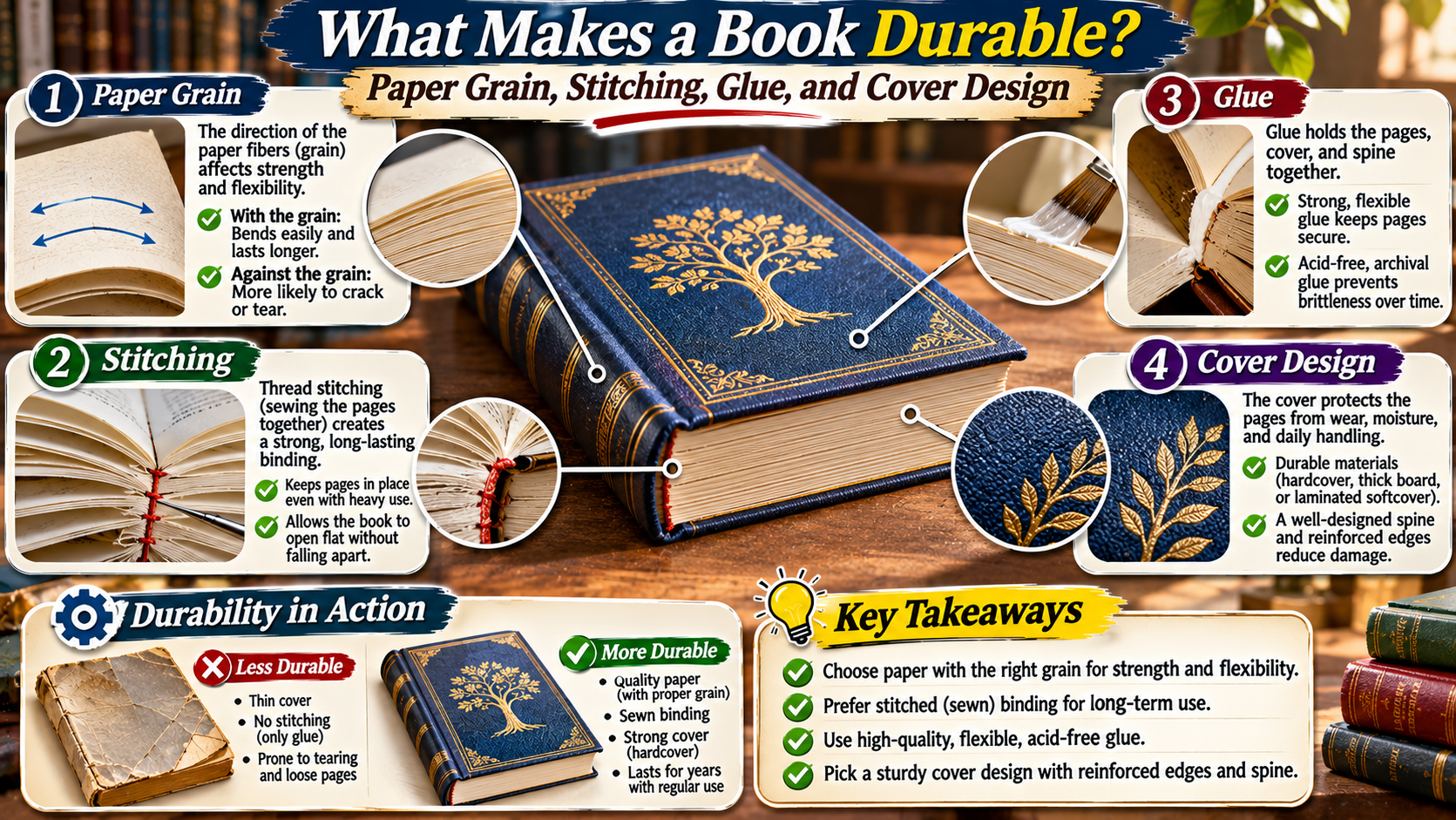
Paper grain refers to the predominant alignment of fibers created during the papermaking process.
Machine-made paper typically has a grain direction because fibers tend to align as the sheet is formed.
Paper generally bends and folds more easily parallel to its grain than across it.
This difference matters greatly in bookbinding.
For most conventional books, the preferred grain direction runs parallel to the spine.
This allows pages to turn more naturally and helps reduce resistance near the binding edge.
When the grain runs perpendicular to the spine, pages may resist opening and become more prone to distortion.
Humidity changes can also cause paper to expand differently along and across the grain.
Incorrect grain direction may therefore contribute to warping or uneven movement.
BOOKBINDING PRINCIPLE / PAPER GRAIN
For Most Books, Paper Grain Should Run Parallel to the Spine.
Correct grain direction improves flexibility and helps the pages respond more naturally when the book opens and closes.
How to Recognize Paper Grain
Bookbinders use several methods to identify grain direction.
One simple approach is to gently bend a loose sheet in two directions.
The sheet usually bends more easily in the direction parallel to the grain.
Another method involves observing how paper curls when exposed to moisture, although this should not be attempted on valuable books.
Professional printers and binders normally identify grain direction before cutting and folding sheets.
Paper Quality and Long-Term Preservation
Grain direction is only one aspect of paper durability.
The chemical composition and physical properties of paper also influence its lifespan.
Some papers become brittle because of acidic components and chemical deterioration.
Acid-free or alkaline papers are often preferred for books intended for long-term preservation.
However, the term acid-free alone does not guarantee permanence.
Fiber quality, manufacturing methods, environmental exposure, and storage conditions also matter.
Paper thickness can influence handling resistance, but thicker paper is not automatically more durable.
A relatively thin, well-made sheet may withstand repeated use better than a thicker sheet with poor flexibility or unstable chemistry.
For archival applications, publishers and institutions may use paper that meets recognized permanence standards.
Sewn Binding: Why Stitching Can Improve Durability
Sewn bindings use thread to connect folded groups of pages called signatures or sections.
The signatures are assembled and sewn together before the book receives its final spine treatment and cover.
This creates a mechanical connection between sections.
In a well-designed sewn binding, the thread helps hold pages together even as the book flexes during use.
Sewing is common in many higher-quality hardcover books, reference works, and editions intended for repeated handling.
However, not every sewn book is automatically durable.
Thread quality, stitch pattern, paper strength, and the overall binding design still affect performance.
Poorly executed sewing can damage folds or create weak points.
When properly constructed, sewn bindings can offer an excellent balance of flexibility and strength.
Smyth Sewing
Smyth sewing is a widely used commercial method for sewing folded signatures together.
It creates a connected text block that can open flexibly while retaining structural support.
This technique is often associated with durable books intended for frequent use.
The final result still depends on how the sewn text block is attached to the cover and reinforced at the spine.
Glue Binding: Convenient but Highly Dependent on Materials
Many paperback books use adhesive binding rather than stitching.
In perfect binding, individual leaves are secured along their spine edges with adhesive.
The cover is then attached around the text block.
This method is efficient and widely used for mass-produced books.
Its durability depends heavily on the adhesive, paper characteristics, spine preparation, and manufacturing process.
Some older or poorly manufactured adhesive bindings become brittle and crack.
Others remain functional for many years.
Modern adhesive technologies can provide strong and flexible bonds when correctly applied.
EVA and PUR Adhesives
Ethylene-vinyl acetate, commonly called EVA, is used in many hot-melt bookbinding applications.
Polyurethane reactive adhesive, or PUR, is another option.
PUR can offer strong adhesion and flexibility across a range of paper types when properly processed and cured.
However, neither adhesive should be judged independently of the complete binding system.
Application temperature, adhesive thickness, paper coatings, and production quality all influence the result.
BINDING COMPARISON / STRUCTURAL DESIGN
Sewn Binding
Uses thread to connect folded sections. Often offers excellent flexibility and long-term serviceability when properly constructed.
Adhesive Binding
Uses glue to secure page edges. Can be durable, but performance depends strongly on adhesive selection and manufacturing quality.
Why the Spine Must Be Strong and Flexible
The spine is one of the most mechanically demanding parts of a book.
It supports the assembled pages while allowing them to open.
If the spine is too rigid, opening the book may place excessive stress on the binding and paper.
If it is too flexible without adequate support, the text block may deform or become unstable.
Some bindings incorporate reinforcing materials such as cloth, paper, or other flexible layers.
These materials help distribute forces and strengthen the connection between the text block and cover.
Spine construction also influences how comfortably a book lies open.
A well-designed spine allows normal reading without requiring excessive force.
Hardcover Design: Protection Beyond Appearance
Hardcover books generally use rigid boards covered with cloth, paper, leather, or another material.
The boards help protect the pages from bending and external damage.
However, the durability of a hardcover depends on more than board thickness.
The cover must be connected securely to the text block.
Endpapers often play an important role in this connection.
The joints near the spine must also tolerate repeated opening.
A heavy cover with weak hinges may fail even when the boards themselves remain intact.
Good hardcover construction therefore combines protective materials with carefully designed movement points.
Why Book Hinges Matter
The hinge is the flexible region where the cover opens beside the spine.
It experiences repeated bending during normal use.
If the hinge material is weak or poorly attached, the cover may separate from the text block.
Strong hinge construction helps extend the life of frequently handled books.
Paperback Covers and Protective Finishes
Paperback covers are typically made from flexible cardstock.
They are lighter and often less expensive to manufacture than rigid covers.
Cover durability depends on paperboard strength, flexibility, coating, and the quality of the fold near the spine.
Some paperbacks use laminated or coated covers to improve resistance to scuffing and moisture exposure.
However, coatings can also crack if the cover is repeatedly bent beyond its intended flexibility.
Proper scoring helps create controlled folds and reduces unwanted stress.
A well-made paperback can remain in good condition for many years, particularly when stored and handled carefully.
How Different Binding Methods Compare
| Binding Type | Main Construction | Durability Considerations |
|---|---|---|
| Sewn Hardcover | Sewn sections with rigid boards | Often strong and flexible; hinges and materials remain important |
| Perfect-Bound Paperback | Adhesive-secured leaves | Highly dependent on glue quality and spine preparation |
| Case-Bound Hardcover | Text block attached to a separate hard cover | Durability depends on text-block binding and case attachment |
| Spiral Binding | Pages secured by a coil | Opens flat but coils and punched holes can be damaged |
| Saddle Stitching | Staples through folded sheets | Practical for thin publications; not suitable for very thick books |
How Book Size and Weight Affect Durability
Large and heavy books place additional demands on their bindings.
A thick text block creates more weight for the spine and cover joints to support.
Oversized books may also experience greater stress when opened on an unsupported surface.
For this reason, large reference books often require carefully selected materials and reinforced construction.
Paper weight, page count, and cover dimensions should be considered together during design.
A binding suitable for a small paperback may not perform equally well on a heavy illustrated volume.
Why Storage Conditions Matter
Even a well-constructed book can deteriorate under unsuitable storage conditions.
Excessive humidity encourages mold growth and can distort paper and boards.
Very dry conditions may affect certain binding materials.
Heat and direct sunlight can accelerate chemical deterioration and fading.
Frequent exposure to moisture can also weaken some adhesives and cause pages to swell.
For everyday books, stable indoor conditions are generally preferable to damp basements, hot attics, or areas exposed to direct sunlight.
Books should also be supported appropriately on shelves.
Very large or heavy volumes may benefit from horizontal storage when suitable.
How to Recognize a Well-Made Book Before Buying
BOOK QUALITY / INSPECTION CHECKLIST
Check the opening action. A book should open comfortably without requiring excessive force.
Examine the spine. Look for visible cracking, separation, or unusual stiffness.
Inspect the pages. Pages should remain securely attached during normal handling.
Look at the cover joints. Hinges should move smoothly without obvious tearing.
Consider paper quality. Paper should feel appropriate for the book’s intended use and should not show obvious brittleness.
Check the overall construction. The cover, spine, and text block should appear properly aligned.
Remember the limitations. Some durability characteristics, including adhesive chemistry and long-term paper stability, cannot be determined by visual inspection alone.
Frequently Asked Questions
What makes a book durable?
Durability depends on paper quality, correct grain direction, binding construction, adhesive performance, cover strength, and suitable storage conditions.
Why is paper grain important in bookbinding?
Paper generally bends more easily parallel to its grain. Aligning the grain with the spine helps pages turn naturally and reduces stress.
Are sewn books stronger than glued books?
Well-made sewn bindings often provide excellent durability and flexibility, but high-quality adhesive bindings can also perform well.
What is the difference between EVA and PUR glue?
Both are used in commercial bookbinding. PUR can offer strong, flexible adhesion across many paper types, while EVA is widely used in conventional hot-melt binding.
Are hardcover books always more durable?
No. Hardcover boards provide protection, but the binding, hinges, paper, and construction quality determine overall durability.
Why do some paperback spines crack?
Cracking can result from adhesive brittleness, excessive opening force, poor construction, aging, or unsuitable storage conditions.
How should books be stored for long-term preservation?
Keep them in stable indoor conditions away from excessive moisture, heat, direct sunlight, and unnecessary mechanical stress.
Final Thoughts
A durable book is the result of thoughtful material selection and careful construction.
Paper grain influences flexibility and page movement.
Sewn bindings create mechanical connections between folded sections, while adhesive bindings rely on the quality of the glue and its application.
Spine design determines how the text block responds to repeated opening.
Cover boards, hinges, and protective finishes help shield the pages from physical damage.
All these elements work together to influence how a book ages.
Understanding them reveals why some books survive generations of reading while others deteriorate much sooner.
Whether a book is a paperback novel, a family reference volume, or a carefully produced collector’s edition, its durability begins with the decisions made during design and binding.