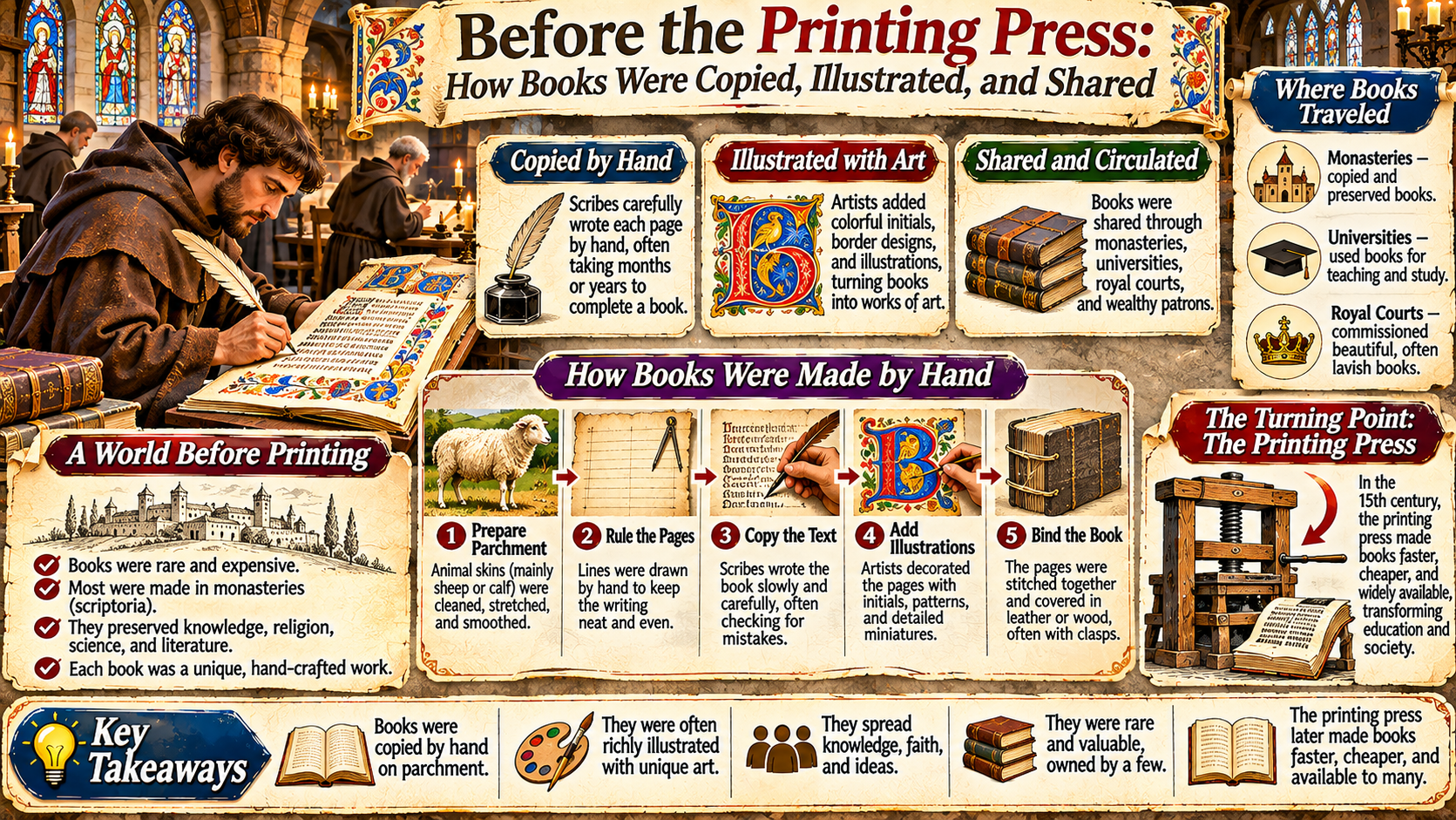
For more than three centuries following Johannes Gutenberg’s 15th-century breakthrough, the fundamental physical construction of the printing press remained remarkably static. Known collectively as the common wooden press, these machines were constructed primarily of dense, seasoned hardwoods—predominantly European oak, beech, and walnut—mortised and tenoned together into a massive vertical timber frame. Pressure was applied through a heavy iron or brass screw turned by a hand lever, driving a wooden platen downward against an inked typographic form resting on a stone bed.
While the wooden common press served the intellectual needs of early modern Europe, its mechanical architecture imposed severe physical limitations. Wood is an inherently elastic, hygroscopic material that expands, contracts, and yields under hydraulic stress. Because the wooden platen could exert only modest compressive force without fracturing the cross-beams, printers could print only half a sheet of paper at a time. A full broadside or folio sheet required the printer to pull the lever, crank the bed forward with a rounce handle, and pull the lever a second time—a cumbersome workflow known as ‘printing in two pulls’.
Lord Stanhope and the First All-Iron Press (1800)
The historic transition from wood to iron was achieved in England in 1800 by Charles Stanhope, 3rd Earl Stanhope. In collaboration with the skilled engineer Robert Walker, Stanhope cast the entire frame of the press from a single massive iron casting. More importantly, Stanhope discarded the direct screw lever in favor of a sophisticated compound toggle lever mechanism.
Stanhope’s compound linkage functioned as a mechanical multiplier: as the pressman pulled the bar, the mechanical advantage increased progressively as the platen descended. At the moment of contact with the inked form, the lever exerted maximum compressive pressure with minimal human exertion. For the first time in printing history, a full folio sheet could be printed across its entire surface in a single powerful pull (‘printing at one pull’), doubling the daily output of the pressroom while ensuring sharp, uniform ink coverage.
The Columbian and Albion Presses: The Zenith of Hand Press Engineering
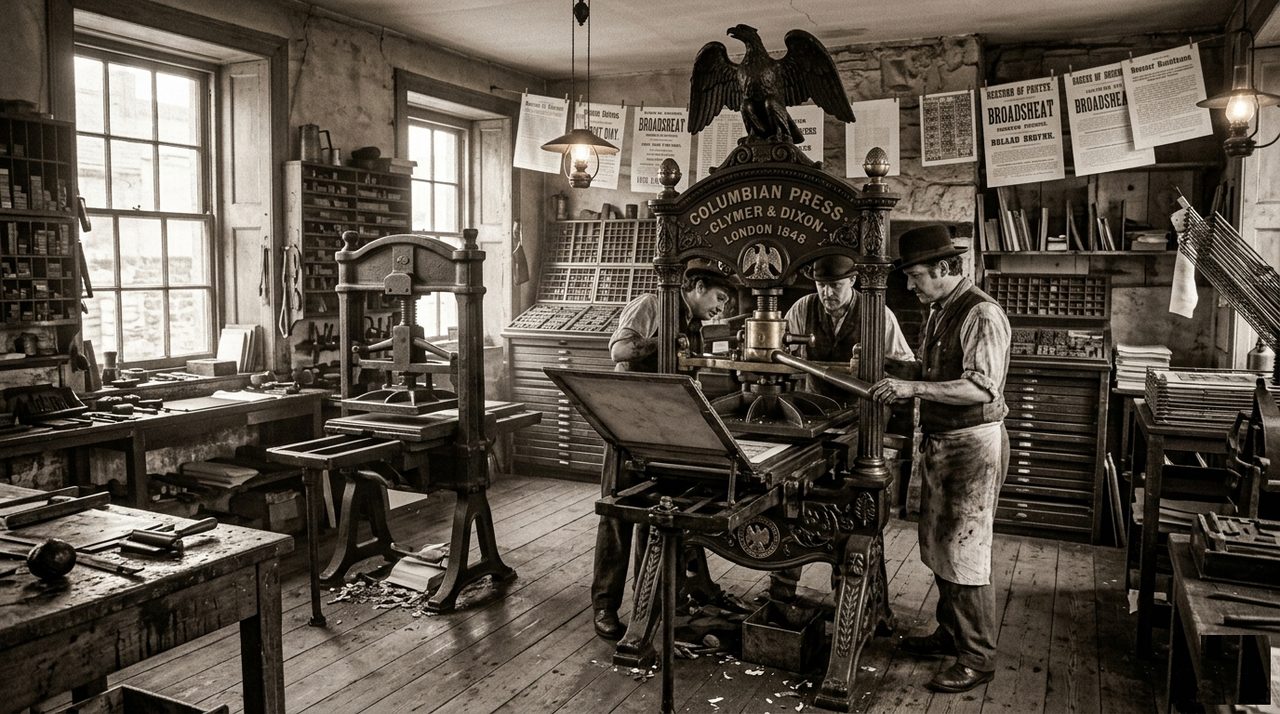
In 1813 in Philadelphia, the American engineer George Clymer introduced the dramatic Columbian Press. Clymer completely eliminated the traditional screw, replacing it with an elaborate series of compound overhead levers counterbalanced by a majestic cast-iron American bald eagle grasping an olive branch and thunderbolts. When the pressman pulled the bar, the eagle lifted, and upon release, its counterweight effortlessly returned the heavy iron platen to its open position. The Columbian exerted unprecedented tonnage, capable of printing dense wood engravings and broadsheets with crisp fidelity.
In England, where Clymer’s flamboyant eagle was met with both admiration and amusement, Richard Whittaker Cope developed the streamlined Albion Press in 1822. The Albion utilized a compact, fully enclosed vertical steel toggle and wedge mechanism. Lighter, less expensive, and mechanically simpler than the Columbian, the Albion became the undisputed workhorse of British commercial job printing and was later immortalized by William Morris at the Kelmscott Press for the resurgence of fine-press bibliographical printing.
Structural Mechanics and Young’s Modulus: Oak vs Cast Iron
The engineering transition from the common wooden press to the Stanhope, Columbian, and Albion presses represents a classic study in structural mechanics and material stiffness. The primary physical limitation of timber construction is its relatively low modulus of elasticity (Young’s Modulus). Seasoned European oak exhibits an elastic modulus of approximately 10 to 12 GPa (gigapascals) parallel to the grain, and less than 1.5 GPa perpendicular to the grain.
When the screw of a wooden press exerted several tons of compressive downward thrust, the horizontal wooden cross-beams (the ‘summer’ and ‘head’) deflected upward, while the vertical cheeks stretched. This elastic deformation absorbed up to 40% of the mechanical energy exerted by the pressman. By contrast, gray cast iron possesses an elastic modulus of approximately 100 to 120 GPa—nearly ten times stiffer than oak. The massive unibody iron frame of the Stanhope press suffered negligible structural deflection under full impression, directing 98% of the mechanical force directly into the typographic form.
Tympan Packing Dynamics and Impression Pressure Distribution
Uniform impression across an iron hand press depends upon the physical properties of the tympan packing—the resilient cushioning sandwich placed between the iron platen and the paper sheet. In an Albion or Columbian press, the tympan consists of an outer parchment or oiled manila tympan sheet backed by varying layers of material:
- Hard Packing: Composed of dense, unyielding materials (smooth Bristol board, calibrated pressboard, or heavy Mylar). Hard packing concentrates force strictly on the printing face, producing the sharpest possible kiss impression on smooth papers without embossing the reverse side.
- Soft Packing: Composed of woven wool felt blankets or soft blotting papers. Soft packing compresses under load, compensating for slight height variations in worn foundry type or warped woodblocks, but forces paper deeper into type counters, producing rounded line edges and noticeable reverse embossing.
By mastering packing calibration and bed leveling (adjusting the four corner wedge bolts beneath the iron bed), 19th-century pressmen achieved micron-level planarity across full broadsheet forms.
Archival Standards, Metallurgy Conservation, and Incunabula Preservation
The material preservation of historical printing machinery, movable lead matrices, and early incunabula imprints is governed by strict international conservation protocols codified by the International Council of Museums (ICOM-CC) and the Library of Congress Preservation Directorate. Incunabula printed prior to 1501 demand specialized environmental controls to halt physical and chemical decay:
When conserving early letterpress imprints, conservators never use synthetic tape or non-reversible modern adhesives. Any tears in incunabula leaves are repaired exclusively with pure Japanese kozo tissue (mulberry fibers) adhered with reversible, purified wheat starch paste (pH 7.0), ensuring that any physical conservation treatment can be safely reversed by future conservators without damaging the original printing artifact.
Frequently Asked Questions on Printing History and Mechanics
Why did Gutenberg’s movable type printing succeed commercially where earlier Asian systems remained localized?
While movable ceramic type (China) and cast bronze type (Korea) predated Gutenberg by centuries, their widespread commercial adoption was hindered by linguistic and metallurgical factors. Chinese and Korean scripts require thousands of distinct ideographic characters, making manual type founding, storage cases, and sorting logistically demanding. The Latin alphabet, conversely, requires only 26 alphabetic characters plus punctuation and ligatures (around 150 to 200 sorts total). Gutenberg coupled this alphabetic simplicity with an integrated industrial manufacturing system: the adjustable handheld casting mold for casting identical type shanks, an oil-based printing ink that adhered to metal, and the wooden screw press.
What is the mechanical difference between a ‘one-pull’ and ‘two-pull’ hand press?
On a common wooden press, the platen was only half the size of the press bed because the wooden frame could not withstand the compressive tonnage required to print an entire sheet at once without flexing. The pressman pulled the lever to print the first half of the sheet, cranked the rounce handle to advance the bed, and pulled the lever a second time to print the second half (‘two pulls’). The 1800 Stanhope cast-iron press, with its rigid frame and compound toggle levers, exerted double the force, allowing an entire folio sheet to be printed across its full surface in a single pull (‘one pull’).
How did curved stereotype plates enable high-speed rotary printing?
Locking thousands of individual, loose lead types directly onto a rapidly revolving cylinder was dangerous: centrifugal force inevitably loosened column rules and threw type out of the press. Stereotyping solved this by creating a single, solid, curved metal replica of an entire newspaper page. A flexible papier-mâché ‘flong’ was beaten into the flat type form to create a heat-resistant matrix, which was placed into a semi-cylindrical casting box. Molten lead was poured inside, casting a rigid, curved metal plate that clamped securely onto the rotary press cylinder.
Why did the Linotype machine replace manual typesetting in newspapers but not in fine bookwork?
The Linotype machine cast an entire line of text as a single solid lead bar (‘slug’). While this revolutionized newspaper production by allowing a compositor to set 8,000 characters an hour, it made editorial corrections difficult: if a single typo occurred, the entire slug had to be re-typed and re-cast. The Monotype system, which cast individual, separate pieces of type from a pneumatic paper tape, allowed proofreaders to correct single letters with tweezers, making it the preferred choice for fine book publishers, complex mathematical tables, and scholarly editions.
The Cultural Iconography and Political Weaponry of the Iron Hand Press
Beyond their engineering mechanics, nineteenth-century iron hand presses functioned as powerful cultural and political instruments. The flamboyant cast-iron American bald eagle crowning George Clymer’s Columbian press was not mere decorative whimsy; it was an overt ideological proclamation of republican liberty, democratic enlightenment, and anti-monarchical freedom of the press. As American frontiers expanded westward, small-town newspaper publishers loaded Columbian and Washington iron hand presses onto horse-drawn wagons, transporting the machinery across mountain ranges to establish newspapers in emerging prairie territories.
Because an iron hand press required no external steam or electrical power, it operated with complete self-sufficiency in remote settlements, serving as the sole communal organ for local governance, political debate, legal notices, and public literacy. The physical durability of iron meant that a single press frequently remained in active daily service across three generations of printer-editors.
The Modern Private Press Movement and Albion Press Heritage
At the close of the nineteenth century, as commercial printing was subsumed by roaring industrial steam rotaries, the iron hand press experienced a majestic artistic resurrection through the Private Press Movement. Spearheaded by William Morris at the Kelmscott Press (founded in 1891 in Hammersmith, London), master craftsmen rejected cheap machine-made newsprint in favor of unbleached handmade rag paper, dense black inks, and classic typography pulled by hand on vintage Albion presses.
Morris’s monumental Kelmscott edition of The Works of Geoffrey Chaucer proved that the deliberate, contemplative slowness of the hand press achieved an aesthetic magnificence and physical permanence that mass industrial printing could never rival. Today, private presses and university book arts studios worldwide continue to print limited-edition literary masterpieces on restored 19th-century Albions, preserving the timeless communion between human muscle, iron mechanics, and inked damp paper.