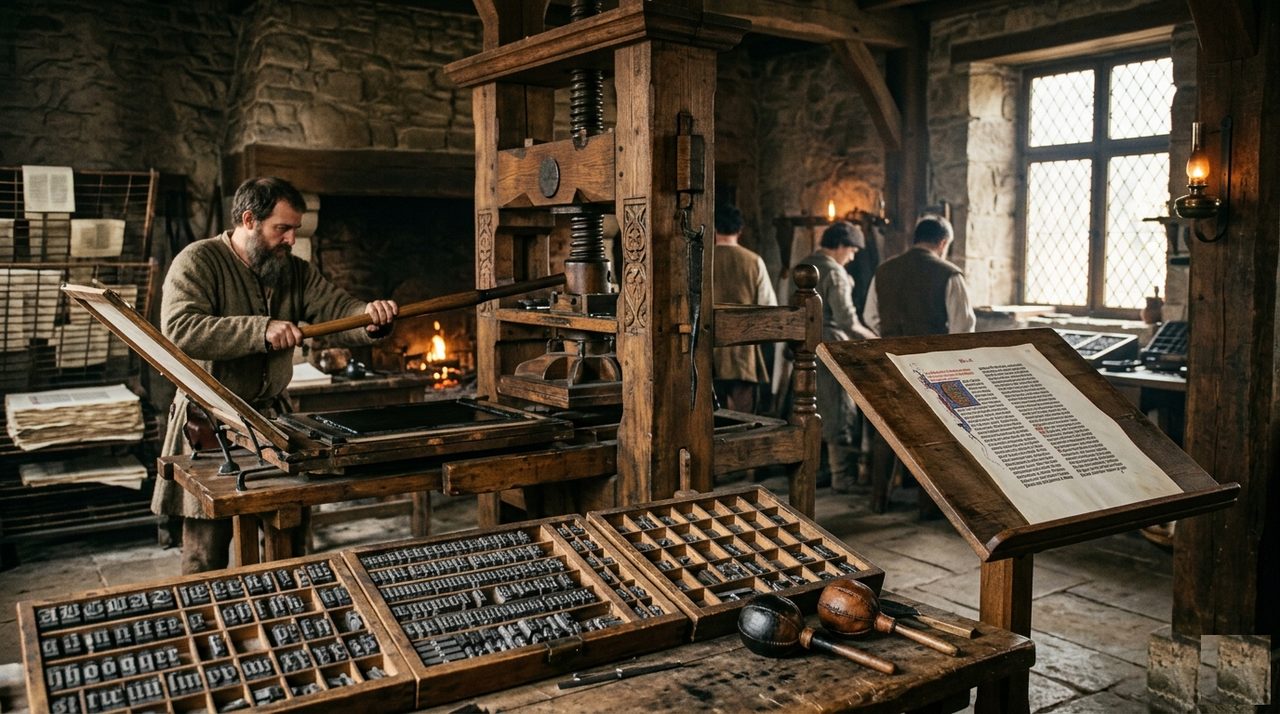
In the mid-fifteenth century in the Rhine River city of Mainz, Germany, a trained goldsmith and gem-cutter named Johannes Gensfleisch zur Laden zum Gutenberg synthesized metallurgy, viticultural pressing mechanisms, and chemical ink formulation to invent European movable metal type printing. While East Asian artisans had previously experimented with ceramic movable type (developed by Bi Sheng in China around 1040 CE) and cast-bronze movable type (perfected in Goryeo-era Korea by Choe Yun-ui for the Jikji in 1377), Gutenberg’s system was the first to achieve sustained industrial mechanization, high typographic fidelity, and explosive commercial scalability.
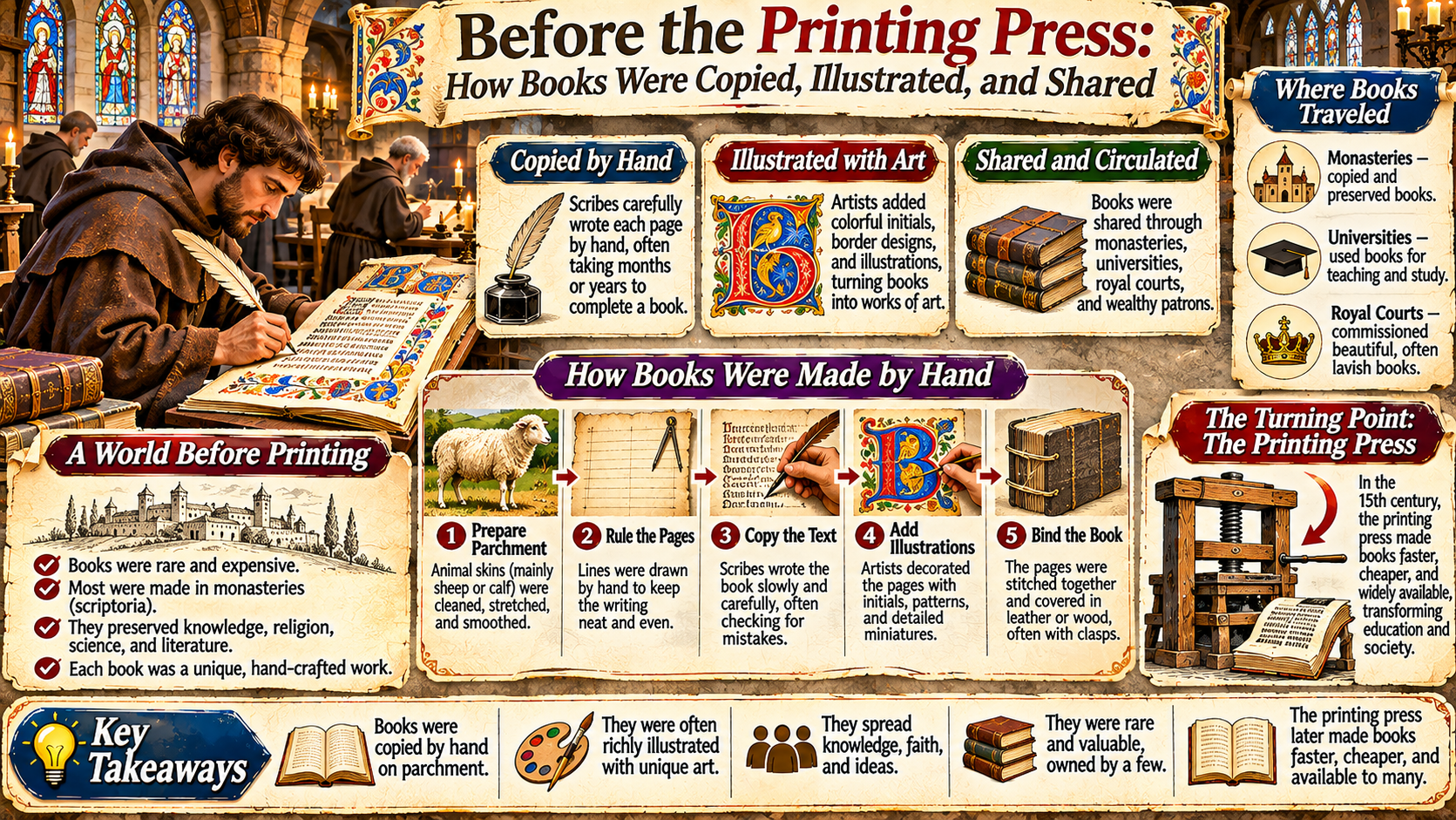
Prior to Gutenberg’s breakthrough, books in medieval Europe were laboriously hand-copied by monastic scribes in scriptoria or carved in entirety onto perishable woodblocks (xylography) for block books. Producing a single illuminated Latin Bible required several scribes working for twelve to eighteen months, consuming hundreds of sheepskins for vellum. Gutenberg replaced this biological bottleneck with a mechanical ecosystem engineered to replicate handwriting with mathematical regularity.
The 42-Line Bible and Early Incunabula Imprints
Between 1450 and 1455, supported by the financial backing of the Mainz venture capitalist Johann Fust and the artistic typographic direction of Peter Schöffer, Gutenberg brought his printing process to commercial realization with the production of the 42-Line Bible (B42). Set in the dense, angular, and stately Gothic liturgical script known as Textura quadrata, the Latin Vulgate edition comprised approximately 180 copies (around 135 printed on high-grade rag paper imported from northern Italy and 45 on calfskin vellum).
The Incunabula Period and European Dispersal (1450–1500)
The term incunabula (derived from the Latin word for ‘swaddling clothes’ or ‘cradle’) designates the embryonic infancy of European printing from Gutenberg’s first imprints through December 31, 1500. Following the sack of Mainz in 1462 during the Diocesan Feud, master printers trained in Gutenberg and Schöffer’s workshop scattered across the trade routes of Europe, carrying punchcutting matrices, casting molds, and press designs to the cultural capitals of the Renaissance.
Conrad Sweynheym and Arnold Pannartz crossed the Alps to establish the first press in Italy at the Benedictine monastery of Subiaco in 1465, later moving to Rome and developing the first humanist Roman typeface to replace German Gothic blackletter. In Venice, Nicolas Jenson perfected the classic Roman letterform in 1470, while the scholar-publisher Aldus Manutius established the Aldine Press in 1494, introducing portable octavo pocket books and italic type. By 1500, printing presses operated in over 250 European cities, producing an estimated 30,000 distinct editions totaling approximately twenty million bound volumes.
Metallurgical Chemistry of the Ternary Lead-Antimony-Tin Alloy
The foundational metallurgical breakthrough of Johannes Gutenberg was the formulation of a specialized ternary eutectic alloy composed of lead (approx. 80%), antimony (approx. 15%), and tin (approx. 5%). This specific chemical recipe was not an accidental mixture, but a masterstroke of metallurgical engineering that solved the physical dilemma of casting precision micro-reliefs.
Pure lead melts at 327°C (621°F) and contracts significantly upon cooling, which would produce sunken, distorted letter faces with blurred serifs. Antimony, an unusual metalloid, possesses the rare physical property of expanding slightly upon crystallization as it transitions from liquid to solid phase. By balancing antimony against lead, Gutenberg created an alloy with negligible net thermal contraction. As the molten metal solidifies inside the hand mold, the antimony expands into every microscopic corner and hairline serif of the copper matrix, casting a razor-sharp, mirror-perfect letterform.
Furthermore, the addition of tin (melting point 232°C) lowers the overall melting point of the eutectic mixture to approximately 240°C to 260°C, reduces surface tension to allow smooth liquid flow into microscopic channels, and increases the ductile toughness of the type shank, preventing the brittle antimony from snapping under repeated press impressions.
Gelatin Sizing and the Hydration Dynamics of Rag Paper
Incunabula printing relied upon handmade paper manufactured from macerated linen and hemp rags. In historical paper mills, raw rags were fermented, beaten with water-powered wooden stampers into pulp, and scooped onto wire mesh hand molds. A critical chemical component was gelatin sizing: dipped into a warm vat of gelatin extracted from animal hides and hooves, mixed with alum (potassium aluminum sulfate).
The gelatin coated the cellulose fibers, creating a semi-permeable capillary barrier that prevented the oil varnish from bleeding (‘feathering’) into the surrounding paper margins. Prior to printing on the wooden press, pressmen dampened the paper sheets overnight between damp boards. This controlled pre-wetting relaxed the cellulose hydrogen bonds, softening the paper so that it molded effortlessly around the metal type under modest pressure, capturing delicate ink films without requiring destructive press tonnage.
Archival Standards, Metallurgy Conservation, and Incunabula Preservation
The material preservation of historical printing machinery, movable lead matrices, and early incunabula imprints is governed by strict international conservation protocols codified by the International Council of Museums (ICOM-CC) and the Library of Congress Preservation Directorate. Incunabula printed prior to 1501 demand specialized environmental controls to halt physical and chemical decay:
When conserving early letterpress imprints, conservators never use synthetic tape or non-reversible modern adhesives. Any tears in incunabula leaves are repaired exclusively with pure Japanese kozo tissue (mulberry fibers) adhered with reversible, purified wheat starch paste (pH 7.0), ensuring that any physical conservation treatment can be safely reversed by future conservators without damaging the original printing artifact.
Frequently Asked Questions on Printing History and Mechanics
Why did Gutenberg’s movable type printing succeed commercially where earlier Asian systems remained localized?
While movable ceramic type (China) and cast bronze type (Korea) predated Gutenberg by centuries, their widespread commercial adoption was hindered by linguistic and metallurgical factors. Chinese and Korean scripts require thousands of distinct ideographic characters, making manual type founding, storage cases, and sorting logistically demanding. The Latin alphabet, conversely, requires only 26 alphabetic characters plus punctuation and ligatures (around 150 to 200 sorts total). Gutenberg coupled this alphabetic simplicity with an integrated industrial manufacturing system: the adjustable handheld casting mold for casting identical type shanks, an oil-based printing ink that adhered to metal, and the wooden screw press.
What is the mechanical difference between a ‘one-pull’ and ‘two-pull’ hand press?
On a common wooden press, the platen was only half the size of the press bed because the wooden frame could not withstand the compressive tonnage required to print an entire sheet at once without flexing. The pressman pulled the lever to print the first half of the sheet, cranked the rounce handle to advance the bed, and pulled the lever a second time to print the second half (‘two pulls’). The 1800 Stanhope cast-iron press, with its rigid frame and compound toggle levers, exerted double the force, allowing an entire folio sheet to be printed across its full surface in a single pull (‘one pull’).
How did curved stereotype plates enable high-speed rotary printing?
Locking thousands of individual, loose lead types directly onto a rapidly revolving cylinder was dangerous: centrifugal force inevitably loosened column rules and threw type out of the press. Stereotyping solved this by creating a single, solid, curved metal replica of an entire newspaper page. A flexible papier-mâché ‘flong’ was beaten into the flat type form to create a heat-resistant matrix, which was placed into a semi-cylindrical casting box. Molten lead was poured inside, casting a rigid, curved metal plate that clamped securely onto the rotary press cylinder.
Why did the Linotype machine replace manual typesetting in newspapers but not in fine bookwork?
The Linotype machine cast an entire line of text as a single solid lead bar (‘slug’). While this revolutionized newspaper production by allowing a compositor to set 8,000 characters an hour, it made editorial corrections difficult: if a single typo occurred, the entire slug had to be re-typed and re-cast. The Monotype system, which cast individual, separate pieces of type from a pneumatic paper tape, allowed proofreaders to correct single letters with tweezers, making it the preferred choice for fine book publishers, complex mathematical tables, and scholarly editions.
The Sociological Impact on Scriptoria and the Democratization of Literacy
The diffusion of Gutenberg’s movable type across late fifteenth-century Europe generated one of the most profound sociological disruptions in recorded history. Prior to 1450, the production and dissemination of written knowledge were monopolized by the Roman Catholic Church, monastic scriptoria, and aristocratic court scribes. Because manual manuscript copying was prohibitively expensive, access to theological, legal, and classical philosophical texts was restricted to a microscopic ecclesiastical and royal elite.
The movable type press shattered this intellectual monopoly. Within five decades of the 42-Line Bible’s publication, the unit cost of book production plunged by upwards of 80%, transforming books from cloistered luxury treasures into accessible commercial commodities. This sudden abundance of printed texts catalyzed the rapid expansion of lay literacy among merchants, municipal burghers, and guild artisans. For the first time, individuals could privately read, compare, and critically debate religious scriptures, legal statutes, and medical treatises without monastic mediation.
The Archival Legacy and Modern Census of Extant B42 Copies
Today, the Gutenberg 42-Line Bible represents the most revered and heavily documented typographic artifact in global cultural heritage. Of the approximately 180 copies originally produced in Mainz, only 49 survive in institutional and national libraries worldwide—with just 21 complete copies containing all printed leaves.
Modern bibliographical scholars utilizing advanced non-destructive synchrotron X-ray fluorescence (XRF) and hyperspectral imaging have analyzed the ink formulations and paper watermarks of extant copies. These scientific audits confirm that Gutenberg’s workshop maintained extraordinary chemical consistency across three years of continuous printing, proving that industrial quality control protocols were integral to the craft from the very inception of European typography. The survival of these imprints for more than five centuries stands as an enduring monument to the permanence of the printed word.