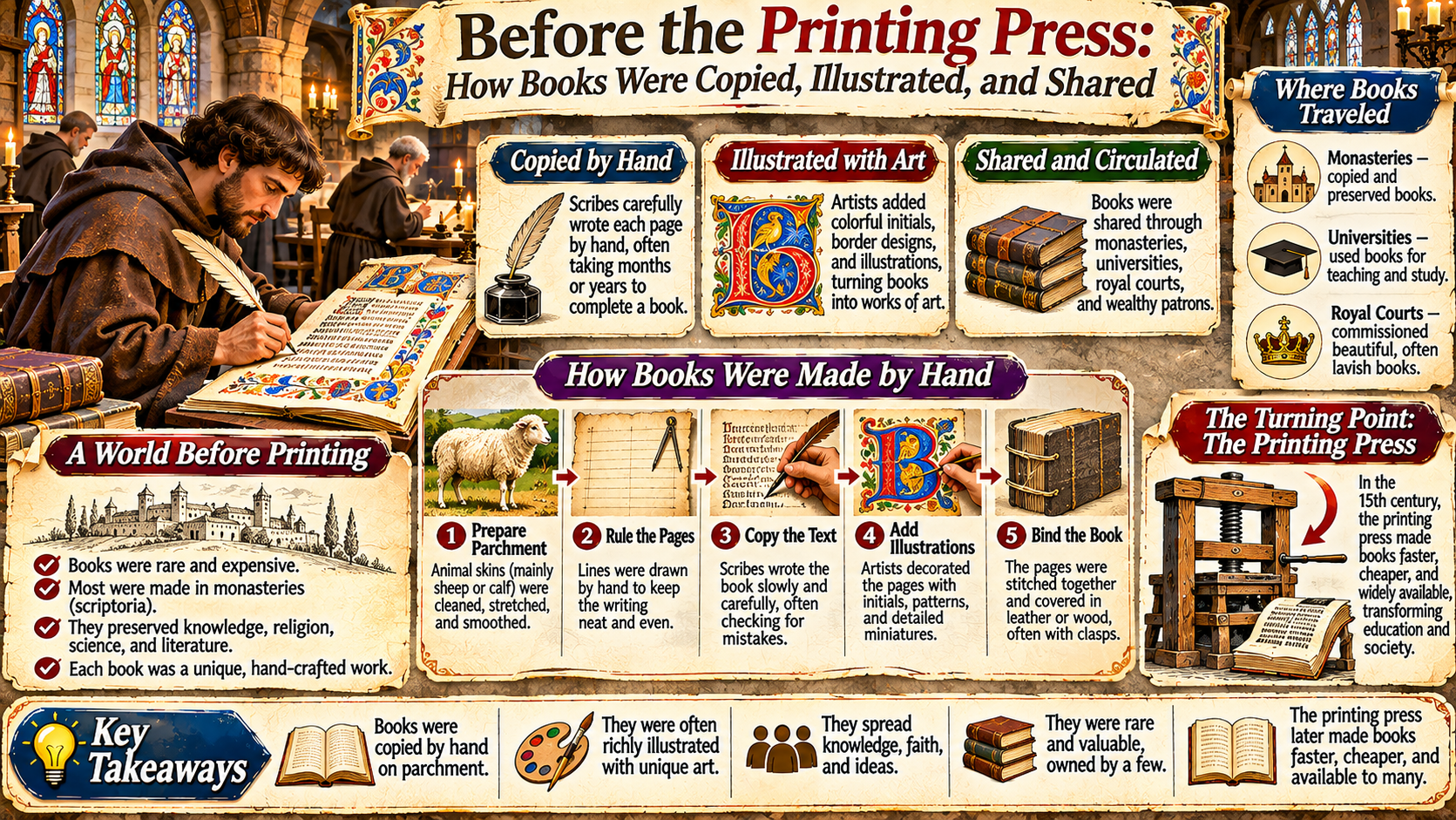
By the late nineteenth century, rotary steam presses could print tens of thousands of newspaper pages every hour. Yet, a severe operational bottleneck paralyzed the printing industry: typesetting was still performed entirely by hand, exactly as it had been in Gutenberg’s workshop four centuries earlier. Compositors stood before wooden type cases, manually plucking individual lead sorts from the compartments of the ‘upper’ (capitals) and ‘lower’ (minuscules) cases, placing them upside down into a composing stick, and manually inserting thin brass and lead spaces to justify each line of text.
An experienced compositor could set approximately 1,200 to 1,500 characters (about 250 to 300 words) per hour. Once the edition was printed, every single piece of type had to be meticulously ‘distributed’ back into its individual compartment, a tedious chore prone to ‘pi’ (accidental spilling and scrambling of type). The global demand for thicker daily newspapers, technical trade manuals, and mass-market pulp paperbacks rendered manual hand composition utterly unsustainable.
Ottmar Mergenthaler and the Linotype Slug Caster (1886)
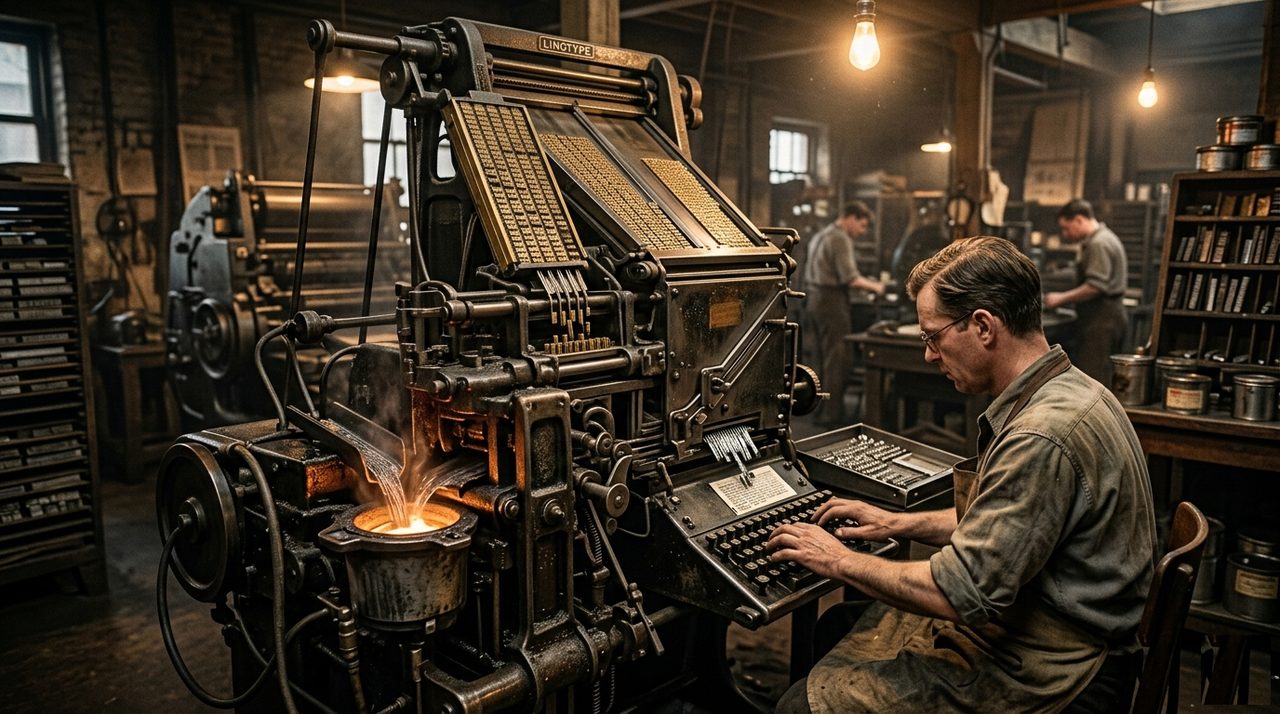
The breakthrough that revolutionized publishing was perfected in Baltimore by German immigrant watchmaker Ottmar Mergenthaler. In 1886, Mergenthaler unveiled the Linotype machine at Whitelaw Reid’s New York Tribune. When Reid witnessed the machine cast an entire line of justified metal type from a keyboard input, he reportedly exclaimed: ‘Ottmar, you have done it! A line-o’-type!’
The Linotype functioned as an integrated mechanical ecosystem consisting of four synchronized subsystems:
- The Keyboard and Magazine: An operator seated at a 90-key matrix keyboard typed copy. Striking a key tripped an escapement lever that released a reusable brass matrix from an inclined overhead magazine, allowing it to slide down a gravity shoot into an assembler elevator.
- Mechanical Justification: Between words, the operator touched a spaceband key, dropping a wedge-shaped two-part steel sliding spaceband. When the line was nearly full, an elevator lever drove the wedges upward, expanding them evenly to justify the line perfectly to the column width.
- Casting Mechanism: The assembled line of matrices was transferred to the casting wheel. A pump plunger forced molten type metal (a low-melting-point alloy of 85% lead, 11% antimony, and 4% tin heated to 280°C / 536°F) into the face of the matrices, solidifying in seconds into a single solid lead bar or ‘slug’.
- Automatic Matrix Distribution: While the slug was trimmed and ejected into a galley tray, an overhead mechanical arm lifted the brass matrices to a revolving distributor bar. Each matrix possessed a unique binary pattern of teeth that matched corresponding keyways along the bar, causing it to drop precisely into its original magazine channel, ready to be reused immediately.
Tolbert Lanston’s Monotype System and Fine Book Composition
While the Linotype dominated the breakneck pace of daily newspaper production, it possessed a notable editorial drawback: if a single comma or letter in a Linotype slug contained an error, the operator had to retype and re-cast the entire line. For intricate book publishing, mathematical treatises, dictionaries, and tabular directories, a more flexible system was required.
In 1887 in Washington, D.C., Tolbert Lanston patented the Monotype System. Unlike the Linotype’s unitary slug caster, Monotype separated the composition and casting operations into two distinct machines: a pneumatic 31-channel paper tape keyboard (the Monotype Keyboard) and an automatic single-character caster (the Monotype Caster). The keyboard operator produced a ribbon of perforated paper tape, which was subsequently fed into the caster. The caster read the tape pneumatically from end to beginning, pre-calculating space widths and casting individual, separate lead types at speeds of 150 characters per minute.
Because Monotype produced loose type identical in quality to foundry type, editors could correct individual characters with a pair of tweezers directly in the chase without re-casting entire paragraphs. Monotype became the revered gold standard for prestigious university presses, Oxford and Cambridge editions, and fine literary book design throughout the twentieth century.
Thermodynamic Phase Equilibrium in Linotype Type Metal
The mechanical feasibility of the Linotype and Monotype systems depended upon precise thermodynamic phase management. In hand typefounding, casting a piece of type took several seconds to cool. A Linotype casting wheel, however, had to inject molten metal, solidify a 30-pica lead bar, trim the foot, and eject the slug within a cycle time of under four seconds!
This rapid cycling was achieved by formulating a near-eutectic alloy containing 84% to 85% lead, 11% to 12% antimony, and 3% to 4% tin. In physical metallurgy, a eutectic mixture has the lowest melting point of any combination of its constituents and undergoes an instantaneous solid-to-liquid transition without an intermediate ‘mushy’ semi-solid plastic phase. The Linotype alloy melts cleanly at 246°C (475°F). The casting pot is maintained at 280°C (536°F). The moment the mechanical pump plunger injects molten metal against the chilled water-cooled casting mold, the alloy solidifies in less than 0.8 seconds, producing a crisp, rigid typographic slug with zero shrinkage voids.
Tribology and Wear Dynamics of Brass Circulating Matrices
A standard Linotype magazine contains over 1,500 individual brass matrices circulating continuously at high speeds: falling down steel chutes, sliding into assembler elevators, undergoing 100 psi compressive clamping during casting, and dropping down distributor tracks. This continuous mechanical cycle creates severe friction and abrasive wear.
Matrices were machined from hard, high-tensile cartridge brass (70% copper, 30% zinc) cold-rolled to strict thickness tolerances within ±0.0002 inches (5 microns). If a matrix sidewall wears by even one-thousandth of an inch, molten type metal squirts between adjacent matrices during casting, creating thin metallic flash lines (‘hairlines’) between letters on the printed page. Composing room technicians maintained rigorous preventative maintenance: cleaning matrices weekly with dry graphite powder (which provides dry, non-greasy lubrication) and never using liquid oils, which attract abrasive lead dust and foul matrix channels.
Archival Standards, Metallurgy Conservation, and Incunabula Preservation
The material preservation of historical printing machinery, movable lead matrices, and early incunabula imprints is governed by strict international conservation protocols codified by the International Council of Museums (ICOM-CC) and the Library of Congress Preservation Directorate. Incunabula printed prior to 1501 demand specialized environmental controls to halt physical and chemical decay:
When conserving early letterpress imprints, conservators never use synthetic tape or non-reversible modern adhesives. Any tears in incunabula leaves are repaired exclusively with pure Japanese kozo tissue (mulberry fibers) adhered with reversible, purified wheat starch paste (pH 7.0), ensuring that any physical conservation treatment can be safely reversed by future conservators without damaging the original printing artifact.
Frequently Asked Questions on Printing History and Mechanics
Why did Gutenberg’s movable type printing succeed commercially where earlier Asian systems remained localized?
While movable ceramic type (China) and cast bronze type (Korea) predated Gutenberg by centuries, their widespread commercial adoption was hindered by linguistic and metallurgical factors. Chinese and Korean scripts require thousands of distinct ideographic characters, making manual type founding, storage cases, and sorting logistically demanding. The Latin alphabet, conversely, requires only 26 alphabetic characters plus punctuation and ligatures (around 150 to 200 sorts total). Gutenberg coupled this alphabetic simplicity with an integrated industrial manufacturing system: the adjustable handheld casting mold for casting identical type shanks, an oil-based printing ink that adhered to metal, and the wooden screw press.
What is the mechanical difference between a ‘one-pull’ and ‘two-pull’ hand press?
On a common wooden press, the platen was only half the size of the press bed because the wooden frame could not withstand the compressive tonnage required to print an entire sheet at once without flexing. The pressman pulled the lever to print the first half of the sheet, cranked the rounce handle to advance the bed, and pulled the lever a second time to print the second half (‘two pulls’). The 1800 Stanhope cast-iron press, with its rigid frame and compound toggle levers, exerted double the force, allowing an entire folio sheet to be printed across its full surface in a single pull (‘one pull’).
How did curved stereotype plates enable high-speed rotary printing?
Locking thousands of individual, loose lead types directly onto a rapidly revolving cylinder was dangerous: centrifugal force inevitably loosened column rules and threw type out of the press. Stereotyping solved this by creating a single, solid, curved metal replica of an entire newspaper page. A flexible papier-mâché ‘flong’ was beaten into the flat type form to create a heat-resistant matrix, which was placed into a semi-cylindrical casting box. Molten lead was poured inside, casting a rigid, curved metal plate that clamped securely onto the rotary press cylinder.
Why did the Linotype machine replace manual typesetting in newspapers but not in fine bookwork?
The Linotype machine cast an entire line of text as a single solid lead bar (‘slug’). While this revolutionized newspaper production by allowing a compositor to set 8,000 characters an hour, it made editorial corrections difficult: if a single typo occurred, the entire slug had to be re-typed and re-cast. The Monotype system, which cast individual, separate pieces of type from a pneumatic paper tape, allowed proofreaders to correct single letters with tweezers, making it the preferred choice for fine book publishers, complex mathematical tables, and scholarly editions.
The Living Legacy and Modern Conservation of Hot Metal Machinery
While the computer revolution rendered hot metal composition commercially obsolete by the 1980s, the Linotype and Monotype systems retain a passionate, vibrant following among contemporary fine-press printers, living history museums, and bibliographical archives. Operating a Linotype—with its hypnotic symphony of clicking keys, sliding brass matrices, clanking spacebands, the pungent aroma of molten lead, and the heavy thump of the ejecting slug—remains one of the most visceral mechanical spectacles in graphic arts history.
Dedicated conservators, such as those at the Museum of Printing in Haverhill, Massachusetts, and the Dale Guild Typefoundry, maintain working hot metal equipment, rescuing tons of irreplaceable matrix libraries from foundry scrap heaps. In fine bookmaking, texts composed on Monotype casters and printed letterpress offer an unmistakable crispness and deep typographic authority that flat digital output cannot duplicate. The century of hot metal composition stands as a testament to the supreme marriage of precision mechanics, typography, and human craftsmanship.