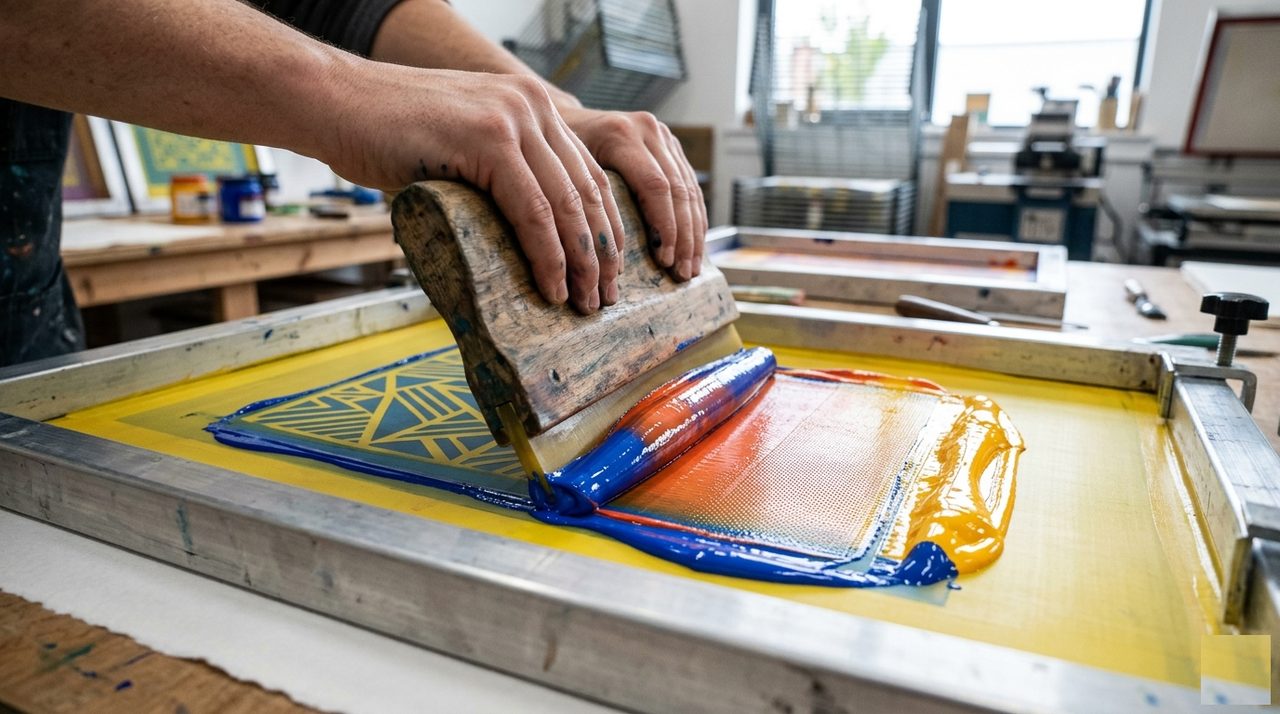
Among the major historical printing disciplines, screen printing (historically termed serigraphy when practiced in fine arts, from the Greek serikos, meaning silk, and grapho, to write) is uniquely distinct: it is a stencil-based, through-the-matrix process. Rather than pressing paper against an inked raised relief, recessed groove, or planographic surface, screen printing forces viscous fluid ink through the open apertures of a finely woven tensioned fabric mesh directly onto the substrate resting beneath.
Originally derived from ancient Chinese and Japanese katazome paper-cutting and hair-stencil traditions of the Song and Edo dynasties, modern screen printing emerged in the early twentieth century with the patenting of silk-gauze stencils by Samuel Simon in Manchester in 1907. Today, screen printing represents the most versatile printing process on earth, capable of depositing heavy, opaque ink layers onto virtually any substrate—including paper, bookcloth, textiles, wood, ceramics, glass, metal, and microscopic printed electronic circuit boards.
Mesh Dynamics: Thread Count, Geometry, and Tensile Measurement
The heart of any screen printing operation is the tensioned screen frame. While original early-twentieth-century screens utilized natural woven Japanese silk fibers, modern technical screen printing relies exclusively on precision-manufactured monofilament polyester or stainless-steel mesh stretched across rigid, hollow-extruded aluminum frames.
Photopolymer Stencils, Squeegee Mechanics, and Ink Formulations
The creation of high-resolution screen stencils was revolutionized by modern direct photopolymer emulsion chemistry. Liquid photoemulsions containing diazo sensitizers or dual-cure polymers are coated evenly onto the degreased mesh with a calibrated scoop coater. When dry, a positive film transparency bearing black artwork is vacuum-clamped against the emulsion and exposed to intense ultraviolet (UV) radiation (typically 365 to 405 nm).
UV photons trigger cross-linking photopolymerization in the clear areas of the film, transforming soluble polymer chains into an insoluble, water-resistant solid barrier. Unexposed areas beneath the black artwork remain water-soluble and wash away cleanly under a high-pressure water spray, leaving pristine, open mesh apertures. During printing, the printer controls three critical physical variables: squeegee blade durometer (ranging from soft 60 Shore A for heavy ink deposits to stiff 80 Shore A for microscopic line resolution), squeegee travel angle (nominally 75 degrees), and off-contact distance (a 2 to 3 mm air gap between screen and paper that allows the mesh to snap cleanly away from the wet ink film immediately behind the advancing blade).
Non-Newtonian Fluid Rheology: Thixotropic Thinning of Printing Inks
Screen printing inks are highly specialized non-Newtonian chemical fluids that exhibit pronounced thixotropic shear-thinning behavior. At rest in the ink container or sitting atop the screen mesh, the ink possesses extremely high apparent viscosity (often exceeding 50,000 to 100,000 centipoise) and a high yield stress. This resting viscosity prevents the ink from dripping through the open mesh apertures under gravity before the squeegee passes.
When the moving squeegee blade exerts hydrodynamic pressure and shear stress on the ink film, the internal polymer and pigment agglomerations temporarily align and decouple. The viscosity of the ink plunges dramatically by several orders of magnitude, transforming it into a fluid liquid that flows effortlessly through the micro-pores of the polyester mesh. The moment the squeegee passes and the screen snaps away, the shear stress drops to zero: the ink film instantly rebuilds its high resting viscosity, freezing in place on the paper substrate without bleeding, creeping, or losing sharp edge acuity.
Photopolymer Cross-Linking Chemistry in Diazo and SBQ Emulsions
Modern direct screen emulsions rely on ultraviolet photopolymerization chemistry. Dual-cure emulsions combine polyvinyl alcohol (PVA) and polyvinyl acetate (PVAc) resins sensitized with aromatic diazo salts. When exposed to 365 nm UV actinic radiation, the diazo molecules undergo photochemical decomposition, generating free radicals that cross-link the surrounding PVA polymer chains into an insoluble, durable polyurethane network.
Pure photopolymer emulsions utilize stilbazolium quaternary salts (SBQ) grafted directly onto the polymer backbone. SBQ emulsions undergo direct [2+2] photocycloaddition under UV light, forming cyclobutane rings in milliseconds. SBQ emulsions expose up to four times faster than diazo emulsions, provide razor-sharp bridging resolution across high-mesh screens (305 mesh), and exhibit superior chemical resistance against aggressive solvent-based and UV-curable printing inks.
Quality Control Standards, Press Calibration, and Ink Rheology
In fine art printmaking and commercial print reproduction, process reliability is governed by international technical standards. For relief and planographic printing, the International Organization for Standardization established ISO 12647-2, which defines target solid ink densities (SID), dot gain curves (TVI – Tone Value Increase), and colorimetric Lab values across standard commercial paper stocks:
In all printing workshops, solvent management and environmental health are governed by OSHA and REACH chemical regulations. Printmakers increasingly deploy low-VOC, vegetable-based ester solvents and water-washable oil inks, which eliminate toxic petroleum distillates while preserving the exquisite tonal fidelity of traditional printmaking.
Frequently Asked Questions on Printing Methods and Technology
What is the difference between relief, intaglio, and planographic printing?
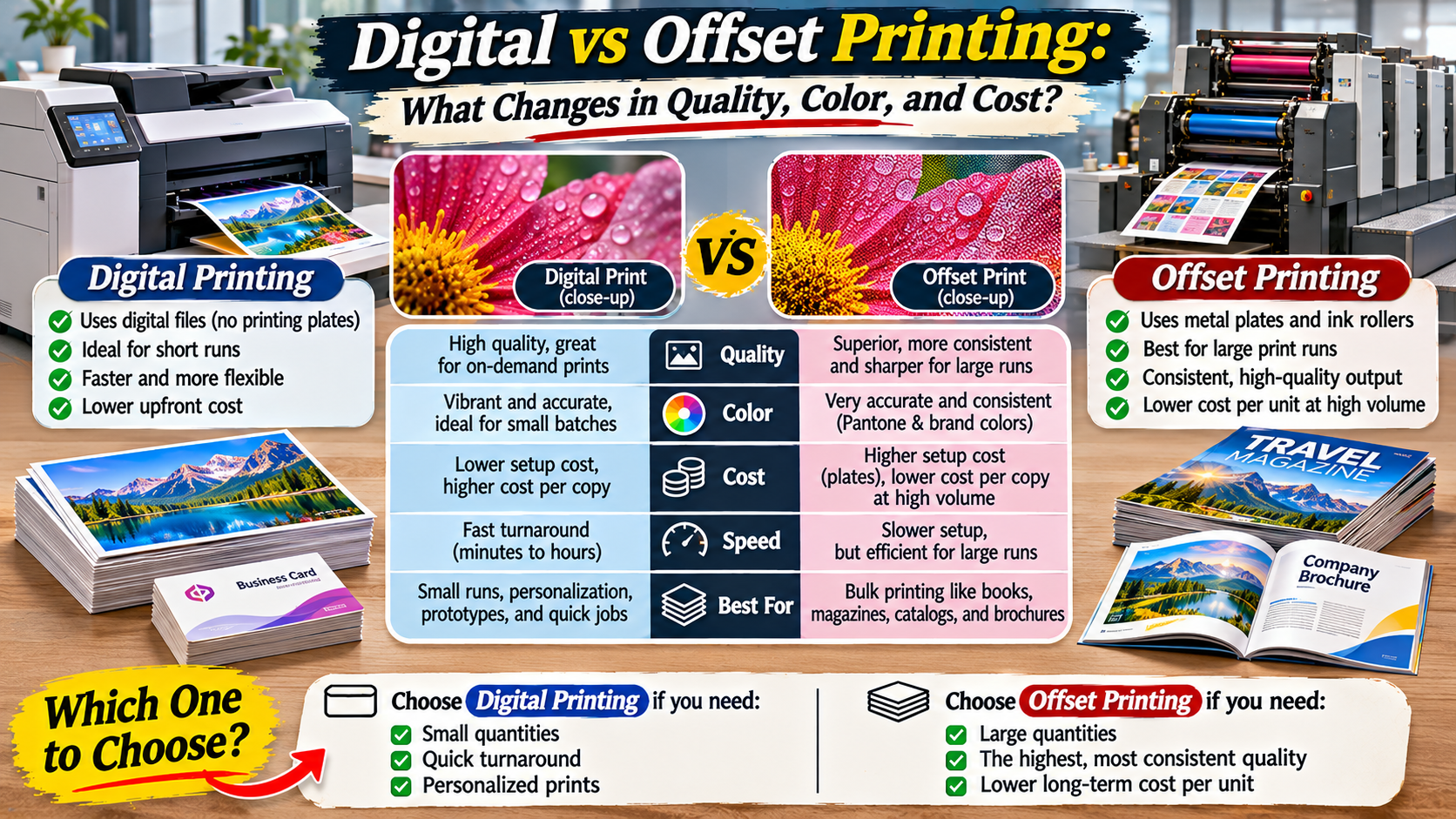
Relief printing prints from a raised surface (the high areas receive ink while carved hollows remain dry, as in woodcuts and letterpress). Intaglio printing prints from recessed grooves (ink is wiped into engraved or etched channels below the surface, as in copper etching and photogravure). Planographic printing prints from an entirely flat plane, utilizing the chemical antagonism between grease and water to repel or attract ink without any physical relief (as in stone lithography and offset printing).
Why must paper be dampened prior to intaglio printing but kept dry for offset lithography?
Intaglio printing requires dampened paper because water acts as a plasticizer, swelling and softening the cellulose fibers so they become pliable enough to be forced deep into microscopic etched grooves under high roller pressure. In offset lithography, paper must remain strictly dry and dimensionally stable: damp paper expands, buckles under the dampening rollers, and misaligns four-color registration while causing ink emulsification.
How does offset printing prevent ink from sticking to the non-image areas of the plate?
Offset printing relies upon a continuous dual-roller inking and dampening system. Before the ink rollers contact the plate, dampening rollers coat the plate with a thin water film containing gum arabic and fountain solution. The chemically prepared non-image areas of the plate are hydrophilic (water-loving) and absorb the water film. When the oleophilic (oil-loving) ink rollers subsequently pass over, the surface tension of the water film repels the oily ink, allowing ink to adhere solely to the dry, greasy image areas.
What role does mesh tension play in multi-color screen printing?
Mesh tension (measured in Newtons per centimeter, N/cm) dictates registration accuracy. If a screen has low or uneven tension, the mesh stretches laterally as the rubber squeegee blade is pulled across it. In a multi-color print job, this stretching causes the second and third color layers to misalign with the first, creating blurred edges and registration gaps. Maintaining uniform tension (20 to 25 N/cm) ensures the mesh snaps cleanly away from the paper without lateral distortion.
Fine-Art Serigraphy: The Pop Art Explosion and Stencil Curation
The transformation of screen printing from an utilitarian industrial marking method into a celebrated fine-art medium—formally rechristened serigraphy—occurred during the American Great Depression under the Federal Art Project (FAP) of the WPA, and achieved global cultural dominance in the 1960s with the Pop Art movement. Visionary artists such as Andy Warhol, Roy Lichtenstein, Sister Corita Kent, and Robert Rauschenberg embraced the process for its bold graphic flat color, democratic accessibility, and unapologetic industrial aesthetic.
Warhol’s silk-screened canvases of Marilyn Monroe and Campbell’s soup cans dissolved the traditional boundaries between high art and mechanical commercial reproduction. In contemporary fine-art serigraphy studios, printmakers layer twenty to forty separate hand-pulled color screens onto heavy 100% cotton printmaking papers (such as BFK Rives or Coventry Rag), creating luminous limited-edition art prints characterized by dense, opaque ink films and rich tactile depth.
Screen Reclaiming Chemistry: Emulsion Stripping and Degreasing
In professional screen printing shops, screen frames and monofilament polyester mesh are valuable reusable assets. Following a production run, the screen must undergo a three-stage chemical reclaiming cycle to restore the mesh to pristine transparency:
High-Tech Screen Printing: Printed Electronics and Photovoltaic Cells
Far from being confined to t-shirts and concert posters, screen printing is an indispensable technology in twenty-first-century advanced electronics manufacturing. Utilizing ultra-fine stainless-steel wire cloth (exceeding 400 to 500 mesh) tensioned to 35 N/cm, automated industrial screen printers deposit conductively doped silver, carbon nanotube, and copper paste inks onto flexible polymer films to manufacture printed electronics: flexible medical biosensors, touch-screen capacitive sensor grids, automobile windshield heating elements, and the silver collector busbars on silicon photovoltaic solar panels.
This remarkable industrial versatility confirms that screen printing has transcended its origins as a simple stencil craft to become an indispensable advanced manufacturing platform across modern aerospace, medical diagnostic, and clean-energy industries worldwide.