Unlike relief printing (which prints from raised surfaces) or intaglio printing (which prints from recessed grooves), lithography is fundamentally planographic—it prints from an entirely flat, non-relief plane. Invented in 1796 in Munich by the aspiring Bavarian playwright Alois Senefelder, lithography bypassed the costly, labor-intensive requirements of carving wood or engraving copper plates. Instead, Senefelder based his revolutionary process upon a foundational law of physical chemistry: the mutual repulsion of grease and water (immiscibility).
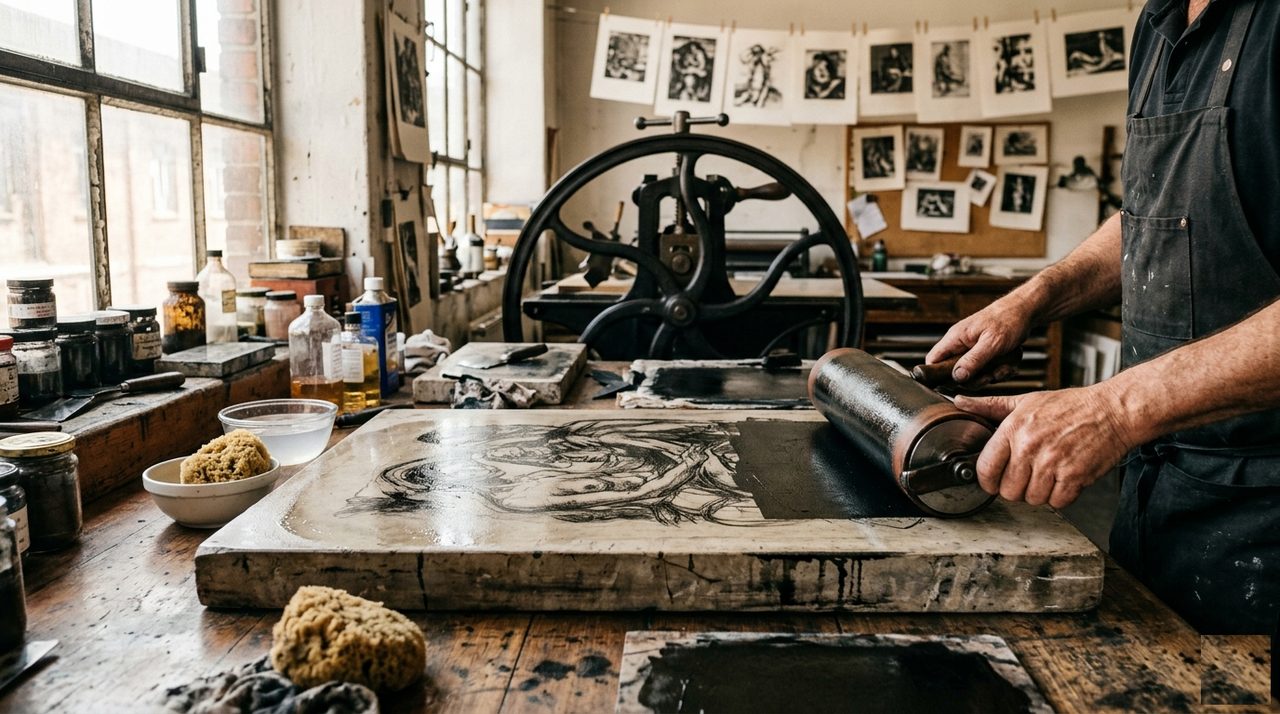
Senefelder’s original matrix was dense, fine-grained Bavarian limestone quarried from the Jurassic strata of Solnhofen. By drawing an image onto the polished stone using a greasy wax crayon or liquid lithographic tusche (composed of soap, tallow, wax, and lampblack), the artist chemically sensitized the calcium carbonate stone to attract oil-based ink while repelling water. Through subsequent chemical preparation with a solution of gum arabic acidified with nitric acid, non-drawn areas of the stone were made permanently hydrophilic (water-attracting and grease-repelling).
The Chemical Preparation: Etching with Gum Arabic and Nitric Acid
The critical transformation of a lithographic drawing into a permanent, reusable printing matrix involves a delicate chemical process known as ‘etching’ (though, unlike intaglio, no physical relief is etched away):
The Leap from Stone to Offset Lithography: Rubel’s Rubber Blanket
While limestone lithography transformed nineteenth-century commercial poster art through the breathtaking chromolithographs of Jules Chéret and Henri de Toulouse-Lautrec, heavy stone slabs were unsuited for high-speed industrial printing. Limestone cracked under rotary press speeds, and direct stone-to-paper printing produced rough, incomplete impressions on textured commercial paper stocks.
The breakthrough that revolutionized 20th-century commercial printing occurred in 1904 in Nutley, New Jersey, engineered by paper manufacturer Ira Washington Rubel. When Rubel’s press feeder accidentally missed a sheet of paper on a stone rotary press, the inked image transferred directly onto the resilient rubber surface of the impression cylinder. When the next sheet entered, it printed on both sides: from the stone on the front, and from the rubber on the back. Rubel observed that the image transferred from the soft rubber blanket was far sharper, denser, and more uniform than the direct stone impression!
Rubel immediately constructed the first three-cylinder offset lithographic press: comprising a plate cylinder (holding flexible grained zinc or aluminum plates), a rubber blanket cylinder, and an impression cylinder. By ‘offsetting’ the ink film from the metal plate to the resilient rubber blanket and then onto the paper, offset lithography conquered high-speed web and sheet-fed printing, becoming the dominant global print technology of the modern era.
Surface Chemistry of the Solnhofen Limestone Reaction
The physical chemistry of stone lithography is governed by the unique crystalline geology of Bavarian Solnhofen limestone—a marine sedimentary deposit formed during the Jurassic period, consisting of 98% pure, microcrystalline calcium carbonate (CaCO3). Solnhofen limestone possesses uniform porosity, an extraordinarily fine grain, and balanced amphoteric chemical reactivity.
When an artist draws with lithographic crayon or tusche containing free fatty acids (predominantly stearic and oleic acids) and sodium stearate soaps, a direct chemical bond forms with the stone. The stearate ions react with calcium carbonate to form insoluble calcium stearate: CaCO3 + 2C17H35COOH → Ca(C17H35COO)2 + H2O + CO2↑. This calcium stearate layer penetrates several microns into the stone’s crystalline lattice, creating an indelible, hydrophobic, oleophilic image plane that permanently attracts oil and repels water.
Offset Rubber Blanket Durometer and Dynamic Ink Film Transfer
In modern industrial offset lithography, the rubber blanket cylinder is the vital mechanical intermediary between the aluminum plate and the paper. The offset blanket is a precision composite composed of three to four plies of woven cotton duck fabric vulcanized with a surface layer of synthetic nitrile butadiene rubber (NBR).
A critical specification is the blanket’s Shore A durometer hardness (typically 75 to 85 Shore A). Modern blankets incorporate an internal layer of closed-cell compressible foam. Under impression nip pressure between cylinders, conventional solid rubber blankets bulge forward and backward, causing dot slurring and mechanical wear. A compressible blanket absorbs the hydraulic nip pressure vertically without lateral displacement, transferring micro-halftone dots from the plate to paper with less than 1% dot distortion at speeds exceeding 15,000 impressions per hour.
Quality Control Standards, Press Calibration, and Ink Rheology
In fine art printmaking and commercial print reproduction, process reliability is governed by international technical standards. For relief and planographic printing, the International Organization for Standardization established ISO 12647-2, which defines target solid ink densities (SID), dot gain curves (TVI – Tone Value Increase), and colorimetric Lab values across standard commercial paper stocks:
In all printing workshops, solvent management and environmental health are governed by OSHA and REACH chemical regulations. Printmakers increasingly deploy low-VOC, vegetable-based ester solvents and water-washable oil inks, which eliminate toxic petroleum distillates while preserving the exquisite tonal fidelity of traditional printmaking.
Frequently Asked Questions on Printing Methods and Technology
What is the difference between relief, intaglio, and planographic printing?
Relief printing prints from a raised surface (the high areas receive ink while carved hollows remain dry, as in woodcuts and letterpress). Intaglio printing prints from recessed grooves (ink is wiped into engraved or etched channels below the surface, as in copper etching and photogravure). Planographic printing prints from an entirely flat plane, utilizing the chemical antagonism between grease and water to repel or attract ink without any physical relief (as in stone lithography and offset printing).
Why must paper be dampened prior to intaglio printing but kept dry for offset lithography?
Intaglio printing requires dampened paper because water acts as a plasticizer, swelling and softening the cellulose fibers so they become pliable enough to be forced deep into microscopic etched grooves under high roller pressure. In offset lithography, paper must remain strictly dry and dimensionally stable: damp paper expands, buckles under the dampening rollers, and misaligns four-color registration while causing ink emulsification.
How does offset printing prevent ink from sticking to the non-image areas of the plate?
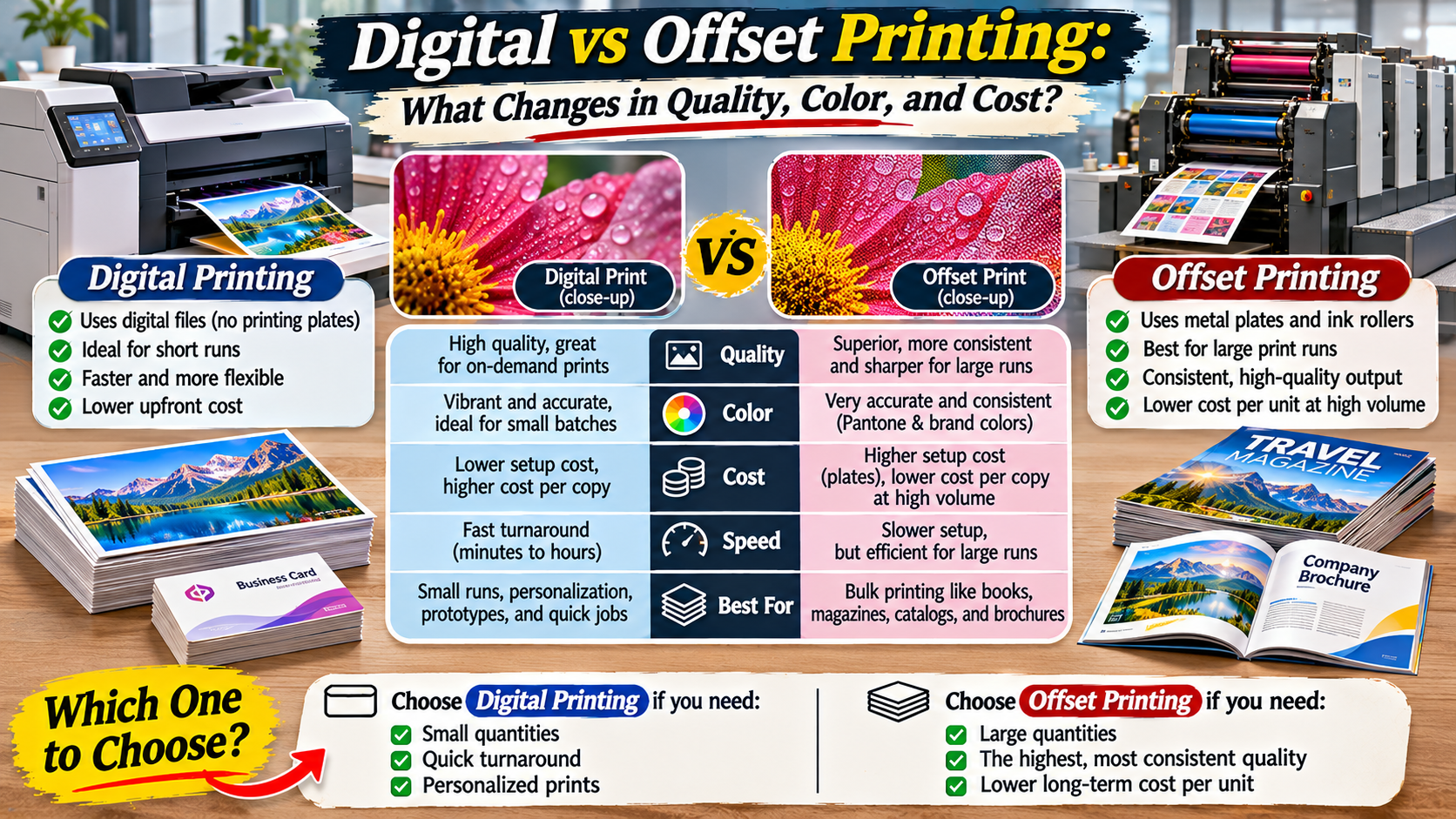
Offset printing relies upon a continuous dual-roller inking and dampening system. Before the ink rollers contact the plate, dampening rollers coat the plate with a thin water film containing gum arabic and fountain solution. The chemically prepared non-image areas of the plate are hydrophilic (water-loving) and absorb the water film. When the oleophilic (oil-loving) ink rollers subsequently pass over, the surface tension of the water film repels the oily ink, allowing ink to adhere solely to the dry, greasy image areas.
What role does mesh tension play in multi-color screen printing?
Mesh tension (measured in Newtons per centimeter, N/cm) dictates registration accuracy. If a screen has low or uneven tension, the mesh stretches laterally as the rubber squeegee blade is pulled across it. In a multi-color print job, this stretching causes the second and third color layers to misalign with the first, creating blurred edges and registration gaps. Maintaining uniform tension (20 to 25 N/cm) ensures the mesh snaps cleanly away from the paper without lateral distortion.
The Art of Stone Grainage: Carborundum Abrasive Mechanics
Before an artist can draw upon a lithographic limestone, the stone must undergo a meticulous physical preparation known as grainage. Because calcium carbonate limestone retains the chemical memory of previous drawings (deeply absorbed fatty acid ions), the surface of the stone must be ground down to expose completely fresh, unadulterated crystalline stone.
The printmaker places the stone in a specialized graining sink, sprinkles coarse silicon carbide abrasive grit (carborundum, starting at 80 grit), adds water, and manipulates a heavy cast-iron grinding disc known as a levigator in rhythmic figure-eight patterns across the surface. Through hours of progressive grinding—advancing from 80 grit down through 150, 220, 280, and finishing at ultra-fine 320 or 400 grit—the levigator planes the stone mirror-flat while creating a delicate, microscopic tooth. This velvety microscopic texture holds the water film during printing and provides tooth for subtle lithographic crayon gradations.
Computer-to-Plate (CtP) Thermal Imaging in Modern Offset Publishing
In industrial commercial book production, the historical intermediary step of burning photonegative films onto plates has been entirely supplanted by Computer-to-Plate (CtP) thermal laser imaging. High-speed multi-beam infrared thermal laser diodes (emitting at 830 nm) scan directly across anodized aluminum plates inside an enclosed vacuum drum platesetter.
Modern plates utilize processless thermal technology: the heat of the laser beam thermally ablates or cross-links the oleophilic polymer coating on the plate with micron precision. The plate requires zero chemical developing baths, zero water rinsing, and zero hazardous chemical waste; it is mounted directly onto the offset press cylinder, where the press’s own inking and dampening rollers automatically remove unexposed polymer during the initial makeready revolutions, slashing pre-press turnaround times while eliminating thousands of gallons of chemical effluent from the printing supply chain.
Waterless Offset Printing and Closed-Loop Color Management
An extraordinary modern evolution of planographic printing is waterless offset lithography (Toray waterless plate system). Waterless offset eliminates the traditional dampening water system entirely. Instead, non-image areas of the aluminum plate are coated with an ultra-thin layer of chemically inert silicone rubber. The silicone surface possesses an extraordinarily low surface energy that naturally repels specialized high-tack printing inks without requiring water.
By eliminating water from the offset press nip, waterless printing eradicates paper stretch, eliminates ink emulsification, reduces makeready paper waste by 80%, and allows the press to print ultra-fine stochastic screening (micro-dots under 10 microns) with breathtaking photographic sharpness, demonstrating that the chemical principles of planographic printing continue to evolve at the bleeding edge of industrial engineering. Furthermore, closed-loop spectrophotometric ink density scanners continually adjust ink fountain keys automatically during high-speed production runs, ensuring microscopic color consistency from the first sheet to the hundred-thousandth impression.