The codex—the familiar bound rectangular volume composed of folded sheets sewn together along one spine edge—is widely regarded as one of the most durable, ergonomically flawless technological architectures in human civilization. Replacing ancient papyrus scrolls and wax tablets in the late Roman Empire, the codex introduced random-access reading, simultaneous front-and-back page writing, protective cover enclosures, and immense bibliographical storage density.
However, a finished book does not begin as a stack of single cut pages. In traditional and industrial book production alike, books are printed on large parent sheets of paper that are systematically folded, gathered, and sewn as cohesive structural units known as signatures (or gatherings / sections). The foundational geometry governing this entire mechanical transformation is known as imposition—the mathematical arrangement of pages on the press sheet such that, upon folding and trimming, every page appears in consecutive numerical sequence and correct upright orientation.
Sheet Formats and Imposition Mathematics: Folio to Octavo
Historical book dimensions and nomenclature are established by the number of times a standard full-sized manufactured sheet of handmade rag paper (such as Royal, Demy, or Crown) is folded:
Paper Grain Physics, Signature Folding, and Collation Marks
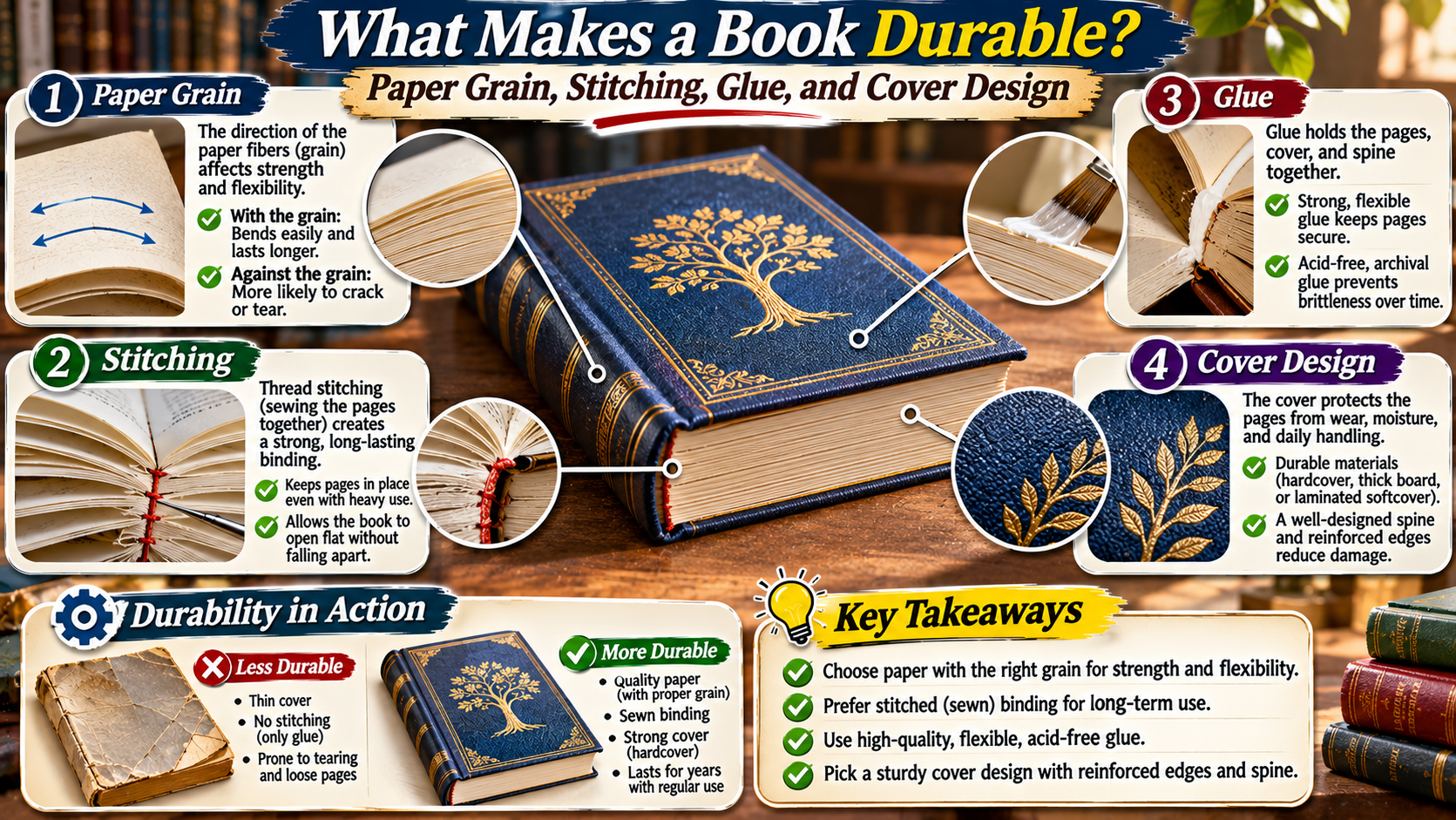
In all mechanical bookbinding, the single most unforgiving rule is paper grain direction. When paper is manufactured on a Fourdrinier wire machine, the cellulose wood or cotton fibers align predominantly parallel to the direction of the moving conveyor belt. Paper folds effortlessly, cleanly, and flatly with the grain; folding across the grain fractures surface fibers, produces unsightly dog-legged ridges, and causes permanent spring-back tension.
In professional book design, the paper grain must run strictly parallel to the spine of the book. This grain alignment ensures that when the book is opened, pages drape gracefully across the reader’s hands and flex without buckling. After folding, signatures are assembled in proper reading sequence during the process of collation. To prevent catastrophic binding errors (such as duplicate or inverted signatures), pressmen print tiny stepped collation marks (black bars) on the outer spine fold of each signature, creating a clean, diagonal staircase pattern down the spine that immediately reveals any misplaced signature to the binder’s eye.
Anisotropic Fiber Alignment and Hygroscopic Paper Expansion
The absolute mandate in bookmaking that paper grain must run parallel to the spine is rooted in the polymer physics of plant cellulose. Plant cellulose fibers are elongated, hollow cylinders composed of crystalline glucose chains. During industrial papermaking on a Fourdrinier machine, paper pulp flows onto a moving wire screen at high velocity, causing the fibers to align predominantly in the machine direction (the grain direction).
Cellulose is fiercely hygroscopic: it absorbs and desorbs ambient water vapor through hydrogen bonding with hydroxyl (-OH) groups. Crucially, a cellulose fiber expands and contracts significantly in its diameter (up to 15% to 20%), but changes minimally in its length (less than 1% to 2%). Consequently, paper expands almost entirely across its grain. If the grain runs perpendicular to the book’s spine, ambient seasonal humidity swings cause the spine to expand vertically against rigid sewing threads and board edges, inducing severe, irreversible spine cockling, wave distortions, and torn endpapers.
Topological Imposition Permutations: The 16-Page Signature Layout
Imposing a 16-page signature for standard sheet-fed printing requires mapping an eight-page front form (outer form) and an eight-page back form (inner form) on a single sheet. The mathematical rule governing standard imposition is that the page numbers of any two adjacent facing pages must sum to N + 1 (where N is the total number of pages in the signature). In a 16-page signature, every facing pair sums to 17 (e.g., page 1 faces page 16 on the flat layout; page 2 faces page 15; page 8 faces page 9 at the center fold).
Furthermore, alternating pages must be inverted 180 degrees (heads-to-heads) so that when the sheet receives its first horizontal fold and two subsequent vertical right-angle folds, all page heads orient upright at the top edge of the book. Verifying imposition geometry prior to burning plates prevents catastrophic binding waste on commercial printing runs.
Archival Bookbinding Standards, Adhesive Chemistry, and Preservation
Archival bookbinding and conservation are governed by the strict standards of the American Institute for Conservation (AIC) and the International Federation of Library Associations (IFLA). A primary directive of archival binding is chemical reversibility: any adhesive, paper lining, or sewing structure applied to a book must be completely removable in the future using benign solvents (such as cold or warm water) without damaging the original textblock fibers.
Furthermore, rare book conservators combat the historic scourge of red rot—the chemical breakdown of 19th-century vegetable-tanned leather caused by residual sulfur dioxide pollutants forming sulfuric acid inside the leather pores. Conservators treat affected leathers with buffer solutions of potassium lactate or non-aqueous Klucel G consolidants, stabilizing the leather matrix and extending the life of antiquarian bindings.
Frequently Asked Questions on Bookbinding and Conservation
Why is paper grain direction critical in bookbinding?
Paper is composed of cellulose fibers that expand significantly in width (up to 15%) when absorbing moisture, but barely at all in length. When paper is folded with the grain, the fibers bend naturally and lay flat. In bookbinding, the paper grain must run parallel to the spine. If the grain runs perpendicular to the spine, the book will resist opening flat, the pages will feel stiff and board-like, and ambient humidity fluctuations will cause the spine to buckle and cockle uncontrollably.
What is the structural purpose of rounding and backing a book?
Rounding taps the flat spine into a semicircular arch, which counteracts the book’s natural tendency to sag forward and become concave over years of shelf storage. Backing hammers the outer signature folds outward at a 90-degree angle, creating distinct ledges or ‘shoulders’. These shoulders accommodate the thickness of the cover boards flush with the spine, providing a solid mechanical hinge that absorbs the opening torque of heavy covers without tearing the paper joints.
What causes ‘swell’ in a sewn textblock, and how is it managed?
Swell is the physical thickening of the spine caused by the accumulated bulk of the sewing thread inside each signature fold. If unmanaged, the spine becomes significantly thicker than the fore-edge, resulting in a wedge-shaped textblock that cannot be properly backed. Binders manage swell by gently compressing the folds with a bone folder between signatures, choosing a thread diameter matched to the signature paper weight, or using ‘two-on sewing’ to halve the amount of thread in each fold.
How does gold tooling bond genuine gold leaf to leather bindings?
Gold tooling relies upon a biological adhesive called glaire (fermented egg white albumin). The binder brushes glaire onto the leather, lays delicate 23-karat gold leaf over the area, and presses a heated brass tool (around 100°C) firmly into the leather. The heat instantly denatures the albumin proteins, fusing the gold permanently into the impressions. Surplus unheated gold is wiped away with a soft rubber pad, leaving gleaming, permanent gold impressions.
Bibliographical Foliation, Pagination, and Signature Registration
In analytical and historical bibliography, scholars maintain a rigorous technical distinction between foliation and pagination. In early medieval codices and incunabula imprints, books were not numbered by page, but by leaf (folio). Each physical leaf contains two pages: the front side facing right is the recto (e.g., Folio 12r), while the reverse side facing left upon turning is the verso (e.g., Folio 12v). Numbering individual pages (pagination) became common only in the mid-sixteenth century as indexing and scholarly cross-referencing matured.
To ensure perfect alignment of printed text across facing pages, pressmen verify register—the exact correspondence of the printed text area on the recto side with the text area on the verso side. When held up to a strong light source, the margins and line baselines of both sides should align within a fraction of a millimeter. Flawless register prevents the dark shadows of reverse-side lines from showing through light margins, preserving optical reading harmony.
The Physics of Rotary Buckle Folding and Knife Folding Machinery
In modern industrial book binderies, folding parent sheets into signatures is performed at colossal speeds by automated folding machines operating on two distinct mechanical principles: buckle folding and knife folding:
Paper Conditioning and Relative Humidity Equilibrium in Binderies
Industrial bookbinders operate under strict climate-controlled warehouse standards. Pallets of printed sheets freshly arrived from the pressroom cannot be folded immediately: they must undergo paper acclimatization. If cold paper from an unheated winter transport truck is unwrapped in a warm bindery, moisture instantly condenses on the pallet edges, causing tight edges, wavy cockling, and severe mis-folding in buckle plates. Paper must rest undisturbed in vapor-barrier wraps for 24 to 48 hours until its internal temperature reaches equilibrium with the bindery atmosphere (ideally 20°C ± 2°C and 50% relative humidity).