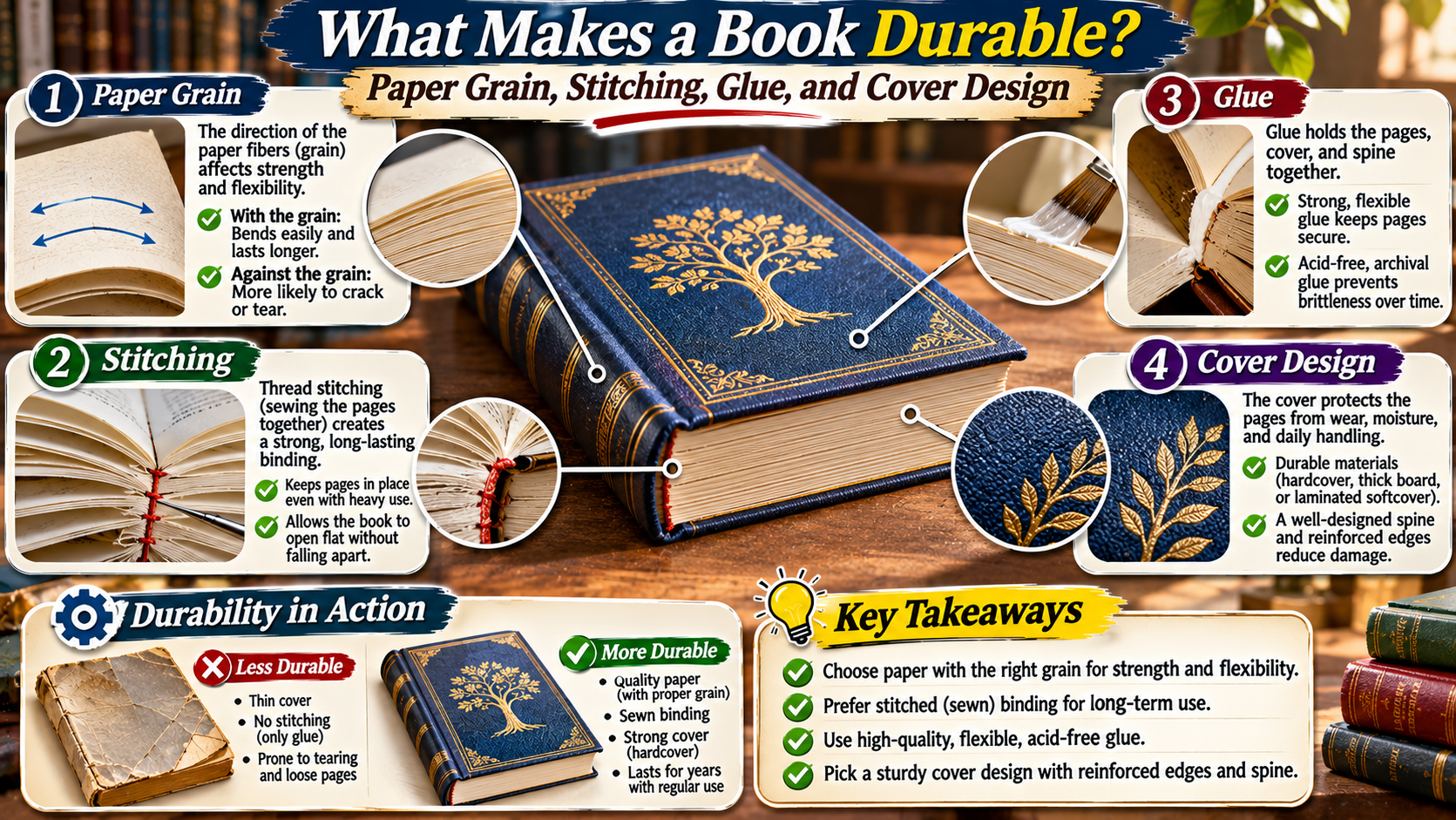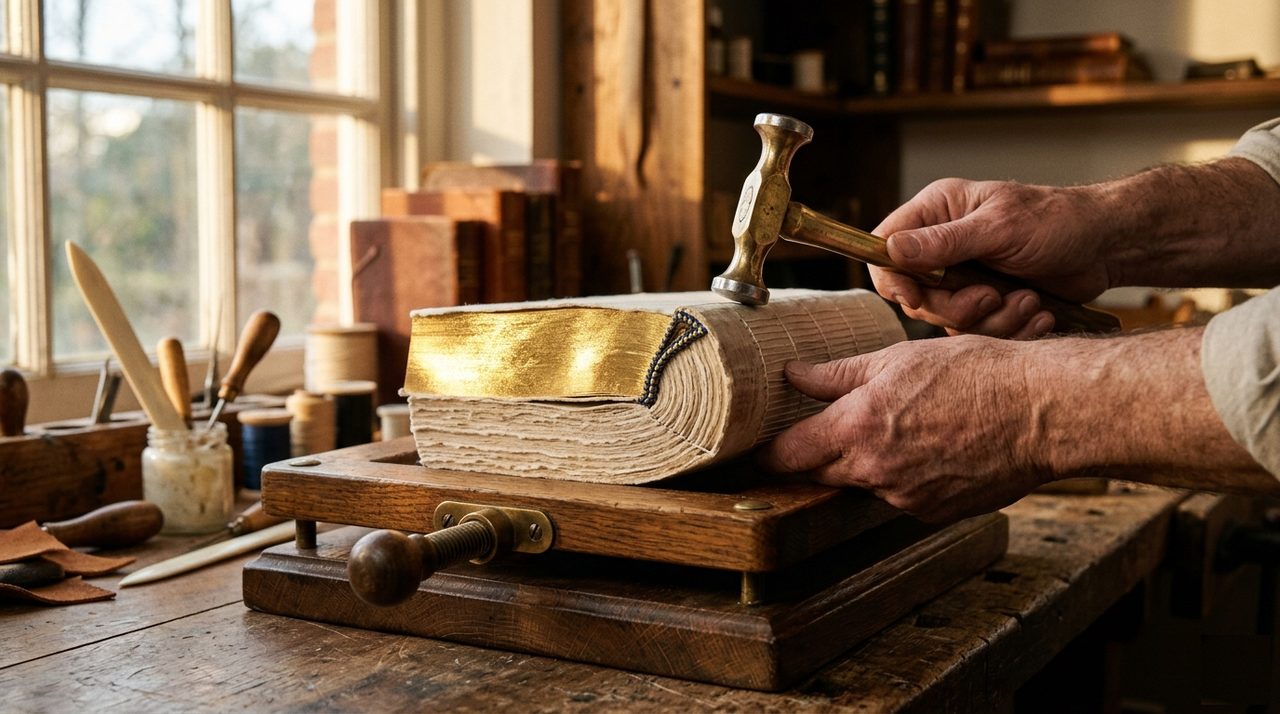
In the lexicon of classical craft bookbinding, the entire progression of operations that transforms a raw, freshly sewn textblock into a structurally sound, shaped, and board-attached volume prior to cover decoration is known as forwarding (distinguished from ‘finishing’, which refers to the exterior leather tooling, gilding, and lettering of the cover). Forwarding is the engineering heart of bookbinding: while beautiful gold tooling on the exterior may charm the eye, poor forwarding guarantees that a book will warp, sag between its boards, or tear its joints after minimal reading.
Forwarding encompasses a rigorous sequence of physical operations: gluing up the spine, trimming the three paper edges, forming the classic convex arch through rounding and backing, gilding or marbling the edges, and hand-weaving structural endbands over silk and cord cores.
The Mechanics of Rounding and Backing
When a raw textblock is sewn, its spine is flat and prone to developing a concavity (the fore-edge pushes outward while the spine collapses inward) as the book is read. To counteract this natural failure mode, the binder executes rounding and backing:
Edge Treatment: Solid Gold Edge Gilding and Hand-Woven Endbands
To protect the interior leaves from environmental dust, soot, and moisture absorption, binders finish the raw trimmed edges through edge gilding. Clamped with extreme torque between wooden gilding boards in a lying press, the raw paper edge is scraped glass-smooth with cabinet scrapers, burnished with agate stone, coated with a red Armenian bole clay glaire primer, and laid with delicate sheets of 23-karat gold leaf. Once dry, the gold is burnished under heavy pressure with a bloodstone or hematite burnisher, creating a mirror-like solid gold surface that seals the paper edges against atmospheric oxidation.
Finally, at the head and tail of the spine, binders weave traditional hand-sewn endbands (headbands). Using fine silk or linen embroidery threads of contrasting colors, the binder sews directly into the center of each signature beneath the kettle stitch, wrapping the thread around a core of rolled vellum, catgut, or compressed leather. These functional headbands protect the delicate head of the spine from being torn when a reader’s finger hooks the top edge to pull the volume from a tight library bookshelf.
Viscoelastic Plastic Deformation in Rounding and Backing
The mechanical transformation of a freshly sewn, flat-spined textblock into an arched, backed volume is an application of viscoelastic plastic deformation of cellulose fibers and dried protein or starch adhesives. When a raw textblock is clamped in a backing press, the binder applies directional hammer blows to the spine folds, sweeping outward from the center line toward the edges.
Under the dynamic shear of the backing hammer, the individual signatures slide slightly over one another, while the folded paper fibers yield past their elastic limit into permanent plastic deformation. The spine folds are bent sharply over the beveled steel edges of the backing boards at an angle of 90 degrees. This creates a permanent, structural shoulder on both sides of the spine matching the exact caliper thickness of the binder’s boards. The backed shoulder locks the circular arch into place: the compressive arch physics distribute gravitational load outward to the cover boards, preventing the textblock from ever sagging forward inside its case.
Spine Lining Laminates: Mechanical Stress and Structural Memory
To control the flexural behavior of the book spine, the binder applies a multi-layered composite laminate over the backed folds. The first layer is invariably a strip of high-tensile Japanese kozo paper adhered with reversible wheat starch paste, which penetrates the paper folds and reinforces the sewing thread anchors.
The second layer is an open-weave starched cotton crash (mull or super), whose woven flanges extend 25 to 35 mm on either side of the spine to serve as structural hinges for board attachment. For large or heavy volumes, a third layer of aircraft linen or heavy archival paper is applied in a specialized ‘hollow back’ configuration (an accordion-folded paper tube). The hollow back allows the spine covering leather to remain independent of the opening textblock: when the book opens, the text arch throws upward while the leather spine flexes outward, preventing the gold tooling on the exterior spine from cracking under bending stress.
Archival Bookbinding Standards, Adhesive Chemistry, and Preservation
Archival bookbinding and conservation are governed by the strict standards of the American Institute for Conservation (AIC) and the International Federation of Library Associations (IFLA). A primary directive of archival binding is chemical reversibility: any adhesive, paper lining, or sewing structure applied to a book must be completely removable in the future using benign solvents (such as cold or warm water) without damaging the original textblock fibers.
Furthermore, rare book conservators combat the historic scourge of red rot—the chemical breakdown of 19th-century vegetable-tanned leather caused by residual sulfur dioxide pollutants forming sulfuric acid inside the leather pores. Conservators treat affected leathers with buffer solutions of potassium lactate or non-aqueous Klucel G consolidants, stabilizing the leather matrix and extending the life of antiquarian bindings.
Frequently Asked Questions on Bookbinding and Conservation
Why is paper grain direction critical in bookbinding?
Paper is composed of cellulose fibers that expand significantly in width (up to 15%) when absorbing moisture, but barely at all in length. When paper is folded with the grain, the fibers bend naturally and lay flat. In bookbinding, the paper grain must run parallel to the spine. If the grain runs perpendicular to the spine, the book will resist opening flat, the pages will feel stiff and board-like, and ambient humidity fluctuations will cause the spine to buckle and cockle uncontrollably.
What is the structural purpose of rounding and backing a book?
Rounding taps the flat spine into a semicircular arch, which counteracts the book’s natural tendency to sag forward and become concave over years of shelf storage. Backing hammers the outer signature folds outward at a 90-degree angle, creating distinct ledges or ‘shoulders’. These shoulders accommodate the thickness of the cover boards flush with the spine, providing a solid mechanical hinge that absorbs the opening torque of heavy covers without tearing the paper joints.
What causes ‘swell’ in a sewn textblock, and how is it managed?
Swell is the physical thickening of the spine caused by the accumulated bulk of the sewing thread inside each signature fold. If unmanaged, the spine becomes significantly thicker than the fore-edge, resulting in a wedge-shaped textblock that cannot be properly backed. Binders manage swell by gently compressing the folds with a bone folder between signatures, choosing a thread diameter matched to the signature paper weight, or using ‘two-on sewing’ to halve the amount of thread in each fold.
How does gold tooling bond genuine gold leaf to leather bindings?
Gold tooling relies upon a biological adhesive called glaire (fermented egg white albumin). The binder brushes glaire onto the leather, lays delicate 23-karat gold leaf over the area, and presses a heated brass tool (around 100°C) firmly into the leather. The heat instantly denatures the albumin proteins, fusing the gold permanently into the impressions. Surplus unheated gold is wiped away with a soft rubber pad, leaving gleaming, permanent gold impressions.
The Hydraulic Physics of the Lying Press and Plough Trimming
Before edges can be gilded or marbled, the raw paper edges of the sewn textblock must be cut glass-smooth. In artisanal binderies, this is accomplished not with a modern power guillotine, but with a traditional bookbinder’s plough and lying press. The textblock is clamped between the massive hardwood cheeks of a lying press under tons of vise screw pressure.
The plough—a specialized wooden frame holding a razor-sharp, spear-pointed steel knife—slides back and forth along the polished wooden guide rails of the press. With each forward stroke, the binder turns a threaded screw a quarter-turn, advancing the blade a fraction of a millimeter into the clamped paper. The knife glides across the edge, shaving individual paper fibers cleanly without crushing or tearing the delicate signature folds, producing an immaculate, flat paper plane ready for the gilder’s scraper.
Edge Marbling: Hydrodynamics and Ox Gall Surface Tension
An exquisite historical alternative to edge gilding is book edge marbling, perfected in 17th-century France and England. Marbling is governed by interfacial fluid surface chemistry. A shallow wooden trough is filled with a viscous ‘size’ prepared by boiling carrageenan moss (seaweed extract) or gum tragacanth in distilled water.
Finely ground mineral pigments suspended in water are mixed with a few drops of ox gall (bile extracted from cattle). The ox gall acts as a powerful natural surfactant, drastically lowering the surface tension of the pigment droplets. When dropped onto the carrageenan bath, the colors do not sink; they spread outward into floating concentric circles. The marbler combs the floating colors with brass rakes into intricate combed patterns (such as Nonpareil, Spanish Wave, or Peacock). The clamped book edge is dipped lightly into the bath: the porous paper fibers instantly absorb the floating pigment pattern, permanently capturing the fluid dance of color across the page edges.
Conservation Ethics: Reversibility in Spine Linings and Structural Repairs
When restoring historical textblocks, conservators operate under the strict ethical doctrine of the Burra Charter and AIC Code of Ethics: minimum intervention and maximum chemical reversibility. Under no circumstances should modern synthetic contact cements, rubber glues, or irreversible cyanoacrylates be applied to historic book spines. Every lining applied over the textblock must be fully reversible in water, ensuring that future scholars and conservators can disassemble the volume for deacidification or repairs without destroying irreplaceable paper fibers.