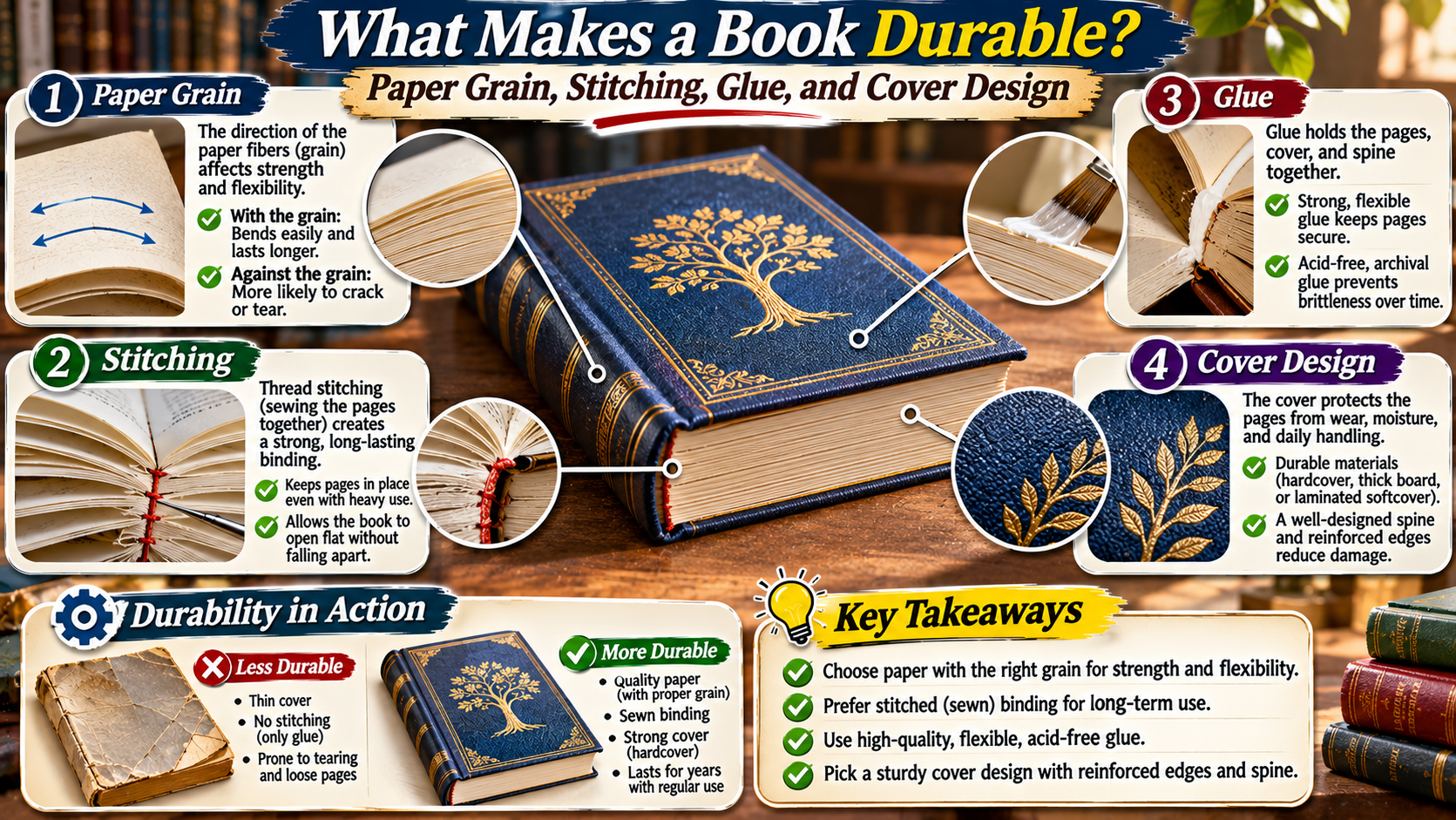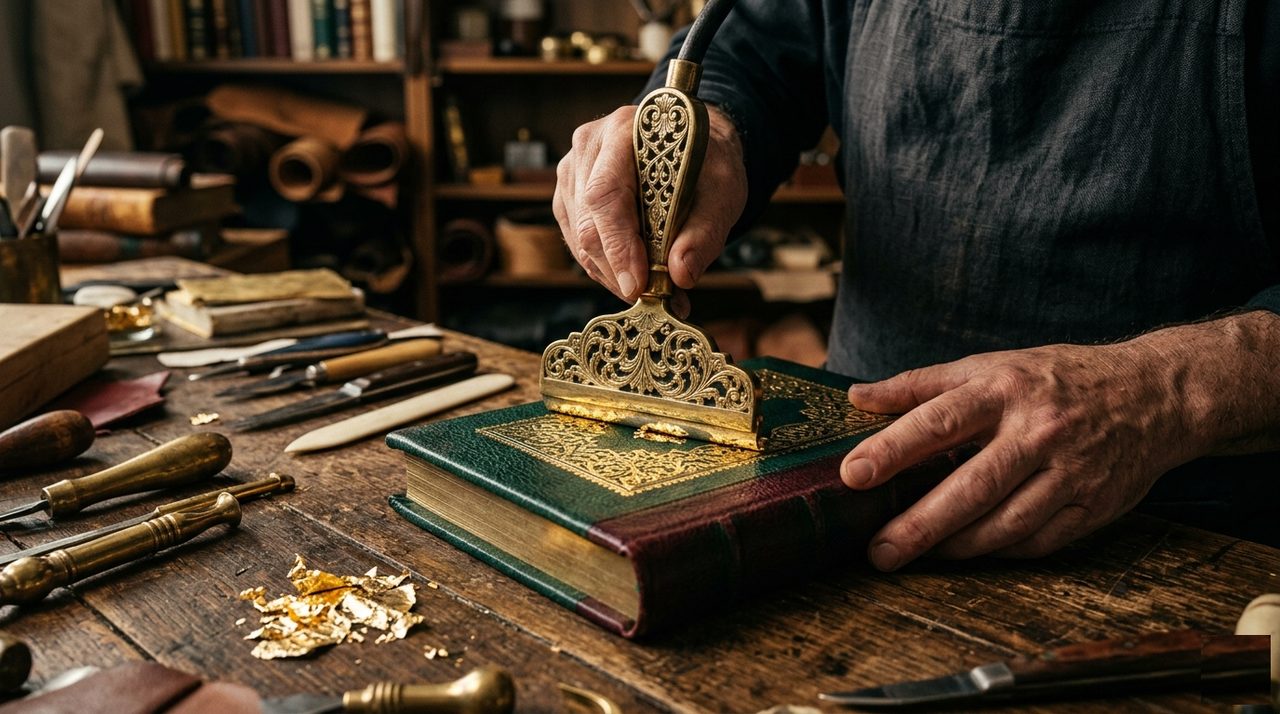
The final, crowning chapter in bookmaking is the creation, attachment, and artisanal decoration of the book’s outer protective enclosure: cover construction and finishing. A book’s cover must fulfill two conflicting architectural demands: it must be rigid and durable enough to protect delicate interior leaves from physical impact, sunlight, and humidity fluctuations, yet possess supple, flexible joints that allow the front and back boards to open smoothly through an arc of 180 degrees without stressing the sewn textblock.
Book construction divides broadly into two distinct historical schools: in-boards binding (where heavy dense binder’s boards are laced directly to the structural sewing cords before covering with leather) and case binding (where the entire cover assembly—comprising boards, spine stiffener, and covering cloth or paper—is fabricated separately off the book and subsequently attached in a single casing-in operation). In finishing, binders transform raw leather into a work of bibliographic art using heated brass tools and hand-laid genuine gold leaf.
Board Selection, Joint Architecture, and Case-Making
The durability of a hardbound book depends heavily upon the structural integrity of the boards chosen to sandwich the textblock:
Artisanal Finishing: Blind Tooling, Gold Tooling, and Titling
Once the book is cleanly covered in vegetable-tanned Morocco goatskin, French calf, or bookcloth, the book enters the finishing department. Finishing ornamentation divides into blind tooling (where heated brass tools are pressed into damp leather to impress dark, polished, indented impressions without color) and gold tooling (where genuine gold leaf is permanently bonded into the leather impressions).
Gold tooling on leather is a demanding physical craft. The binder brushes the leather surface with a biological sizing agent known as glaire (a fermented solution of egg whites and dilute vinegar). Glaire contains albumin proteins that melt under thermal heat. The binder cuts fragile sheets of 23-karat gold leaf on a calfskin gold cushion using a gold knife, lifts the gold with a grease-charged squirrel-hair tip, and lays it across the glaired leather. Heated brass decorative tools, wheels (fillets and roulettes), and brass letter types (heated precisely on a finishing stove to around 100°C / 212°F) are pressed firmly into the gold. The thermal energy denatures the albumin glaire, fusing the gold permanently into the leather pores, while surplus unheated gold is wiped away with a soft rubber pad, leaving brilliant, gleaming golden heraldry and titling.
Collagen Triple-Helix Cross-Linking in Vegetable-Tanned Leather
The supreme covering material for antiquarian bookbinding is vegetable-tanned leather, predominantly Nigerian goatskin (Morocco leather) and French or English calfskin. Unlike modern chrome-tanned upholstery leathers (tanned with mineral chromium salts that yield stretchy, rubbery hides that degrade into acidic green rot over decades), vegetable tanning relies upon organic polyphenolic tannins extracted from oak bark, chestnut wood, or sumac leaves.
These polyphenolic vegetable tannins penetrate the raw hide and form permanent hydrogen bonds across the amino acid chains of the collagen triple-helix fibers, displacing water and locking the fibrous matrix into a durable, dimensionally stable structure. Vegetable-tanned leather possesses unique craft characteristics: it can be dampened with water, molded around raised spine cords, pared with razor-sharp knives to microscopic bevels, and permanently embossed with heated brass finishing tools.
Thermal Denaturation of Albumin Glaire in Gold Tooling
The permanent bonding of genuine 23k gold leaf to leather is a biochemical reaction driven by thermal energy: the heat-induced denaturation of albumin proteins. Traditional bookbinder’s glaire is prepared from the fresh whites of chicken eggs (ovalbumin and conalbumin) beaten to a froth, allowed to settle, and diluted with a small percentage of dilute acetic acid (vinegar) to break surface tension.
When glaire is brushed onto the leather, the globular protein molecules coat the porous surface. When a polished brass finishing tool heated to exactly 95°C to 105°C (203°F – 221°F) is pressed through the gold leaf into the glaired leather, the thermal energy instantly unfolds the tertiary peptide structure of the albumin proteins, causing them to coagulate and cross-link into a solid, insoluble plastic bond that encapsulates the gold atoms. If the tool is too cool (under 85°C), the glaire fails to denature and the gold rubs away; if the tool is too hot (over 115°C), the glaire scorches, burning the delicate collagen leather fibers and dulling the gold luster.
Archival Bookbinding Standards, Adhesive Chemistry, and Preservation
Archival bookbinding and conservation are governed by the strict standards of the American Institute for Conservation (AIC) and the International Federation of Library Associations (IFLA). A primary directive of archival binding is chemical reversibility: any adhesive, paper lining, or sewing structure applied to a book must be completely removable in the future using benign solvents (such as cold or warm water) without damaging the original textblock fibers.
Furthermore, rare book conservators combat the historic scourge of red rot—the chemical breakdown of 19th-century vegetable-tanned leather caused by residual sulfur dioxide pollutants forming sulfuric acid inside the leather pores. Conservators treat affected leathers with buffer solutions of potassium lactate or non-aqueous Klucel G consolidants, stabilizing the leather matrix and extending the life of antiquarian bindings.
Frequently Asked Questions on Bookbinding and Conservation
Why is paper grain direction critical in bookbinding?
Paper is composed of cellulose fibers that expand significantly in width (up to 15%) when absorbing moisture, but barely at all in length. When paper is folded with the grain, the fibers bend naturally and lay flat. In bookbinding, the paper grain must run parallel to the spine. If the grain runs perpendicular to the spine, the book will resist opening flat, the pages will feel stiff and board-like, and ambient humidity fluctuations will cause the spine to buckle and cockle uncontrollably.
What is the structural purpose of rounding and backing a book?
Rounding taps the flat spine into a semicircular arch, which counteracts the book’s natural tendency to sag forward and become concave over years of shelf storage. Backing hammers the outer signature folds outward at a 90-degree angle, creating distinct ledges or ‘shoulders’. These shoulders accommodate the thickness of the cover boards flush with the spine, providing a solid mechanical hinge that absorbs the opening torque of heavy covers without tearing the paper joints.
What causes ‘swell’ in a sewn textblock, and how is it managed?
Swell is the physical thickening of the spine caused by the accumulated bulk of the sewing thread inside each signature fold. If unmanaged, the spine becomes significantly thicker than the fore-edge, resulting in a wedge-shaped textblock that cannot be properly backed. Binders manage swell by gently compressing the folds with a bone folder between signatures, choosing a thread diameter matched to the signature paper weight, or using ‘two-on sewing’ to halve the amount of thread in each fold.
How does gold tooling bond genuine gold leaf to leather bindings?
Gold tooling relies upon a biological adhesive called glaire (fermented egg white albumin). The binder brushes glaire onto the leather, lays delicate 23-karat gold leaf over the area, and presses a heated brass tool (around 100°C) firmly into the leather. The heat instantly denatures the albumin proteins, fusing the gold permanently into the impressions. Surplus unheated gold is wiped away with a soft rubber pad, leaving gleaming, permanent gold impressions.
Bookcloth Chemistry: Starch-Filled vs Acrylic-Coated Fabrics
While leather was the universal covering material for centuries, the mid-nineteenth century industrial revolution spurred the invention of bookcloth—first introduced in London around 1823 by publisher William Pickering and binder Archibald Leighton. Prior to bookcloth, trade books were issued in cheap temporary paper boards intended to be custom-bound in leather by the buyer’s private binder. Bookcloth enabled durable, affordable, uniform publisher’s edition bindings.
Bookcloth falls into two primary technical classifications:
- Starch-Filled Bookcloth (Traditional): Woven cotton or linen fabric whose open weave is completely filled with colored starch pastes and dyed clays, then calendered under heated steel rollers to create glazed, linen, or embossed pebble finishes (e.g., Buckram). Starch-filled cloth possesses a classic, warm, tactile fabric hand, breathes naturally with textblock expansion, and accepts crisp foil stamping, but is vulnerable to water spotting.
- Acrylic-Coated / Impregnated Cloth: Modern cotton fabrics coated with an aqueous acrylic polymer. These materials provide impervious resistance to water, oil, and library soil, making them the standard choice for university library rebinding and high-traffic municipal reference manuals, though they lack the subtle breathability of starch-filled heritage textiles.
Brass Tooling Metallurgy and Finishing Stove Temperature Calibration
Artisanal gold tooling requires specialized finishing tools hand-cast from high-tensile phosphor bronze or typographic brass. Brass is selected because it conducts heat evenly, retains thermal energy during tool travel, and holds razor-sharp engraved relief contours without dulling or oxidizing at elevated temperatures.
Master finishers heat their tools on a specialized gas or electric finishing stove. Temperature calibration is performed using the classic artisan method: touching the heated tool to a water-soaked cotton pad. If the water sizzles gently with a low hiss, the tool is at the ideal gold tooling temperature (approx. 95°C to 105°C / 203°F – 221°F). If it snaps violently with an explosion of steam, the tool is too hot and will scorch the leather; if it does not sizzle at all, the heat is insufficient to melt the glaire. Master finishers develop an intuitive kinesthetic sense of pressure, dwell time, and rocking motion, executing thousands of flawless gold leaf impressions across a single ornate binding. Custom-fitted drop-spine clamshell boxes lined with archival flannel provide museum-grade preservation, safeguarding historic bindings against environmental light, atmospheric dust, and mechanical shelf wear.