In contemporary book manufacturing, the critical nexus where digital graphic design files are converted into physical printing press tooling is known as pre-press engineering. An author’s words and a designer’s typographic layouts may look breathtaking on a high-resolution, backlit sRGB computer monitor, but a printing press does not understand RGB pixels. A commercial offset press understands only physical micro-droplets of viscous cyan, magenta, yellow, and black ink transferred under high mechanical pressure onto fibrous cellulose paper.
Pre-press engineering is the science of translating digital vector geometry and digital raster imagery into microscopic chemical and physical imaging plates. It encompasses color space conversions, trapping tolerances, screening mathematics, raster image processing (RIP), and strict compliance with international PDF/X print exchange standards.
Pre-Press Technical Workflows: From PDF to Computer-to-Plate (CtP)
A commercial print file must navigate a series of rigorous digital and optical transformations prior to press run:
Trapping, Bleed Tolerances, and PDF/X International Standards
On an industrial four-color offset press running at 15,000 sheets per hour, mechanical vibrations and paper stretching under water absorption make absolute registration alignment to the micron impossible. To prevent unsightly white gaps between adjacent colored shapes when plates shift slightly, pre-press engineers deploy trapping—the deliberate, microscopic expansion (typically 0.1 to 0.2 pt) of lighter colors into darker boundary edges.
Furthermore, all elements intended to extend to the very edge of the cut page must incorporate bleed—extending artwork a minimum of 3 mm (1/8th inch) beyond the crop marks to prevent white paper borders during high-speed mechanical guillotining. To guarantee that print files render identically across diverse printing facilities worldwide, the International Organization for Standardization (ISO) established the PDF/X standards (ISO 15930). Conforming to PDF/X-1a or PDF/X-4 guarantees that all fonts are fully embedded, color spaces are strictly defined, compression artifacts are eliminated, and transparency flattening is rendered with mathematical precision.
Colorimetry and Tristimulus Gamut Mapping: CIE L*a*b* to CMYK
The mathematical bridge between digital design and press reproduction is rooted in the colorimetric models established by the International Commission on Illumination (CIE). Digital monitors display images within the device-dependent RGB additive color space, generating colors by exciting red, green, and blue phosphors or sub-pixel LEDs. In commercial offset printing, colors are generated subtractively using four transparent ink films: Cyan, Magenta, Yellow, and Key (Black).
Because the physical gamut of CMYK ink on paper is significantly smaller than the sRGB or Adobe RGB monitor gamuts, pre-press software maps out-of-gamut colors using device-independent CIE L*a*b* color coordinates. In L*a*b* space, L* represents psychometric lightness (0 to 100), while a* (green-to-red) and b* (blue-to-yellow) define chromaticity. Using standardized International Color Consortium (ICC) profiles (such as GRACoL 2013 for commercial sheet-fed offset or Fogra51 for wood-free coated paper), the RIP engine performs gamut compression rendering intents (Perceptual or Relative Colorimetric with Black Point Compensation), smoothly shifting out-of-gamut tones into the printable spectrum without inducing harsh tonal banding.
Total Area Coverage (TAC) Limits and Infrared Drying Dynamics
A critical physical parameter enforced during pre-press pre-flight is Total Area Coverage (TAC), or Total Ink Limit (TIL). TAC represents the sum of the four CMYK dot percentages printed on a single point on the paper sheet. In theory, maximum density would be 100% Cyan + 100% Magenta + 100% Yellow + 100% Black = 400% TAC.
However, if a printing press deposits 400% wet ink film onto paper running at high speed, the paper fibers become oversaturated. The ink cannot dry, resulting in severe set-off (wet ink transferring to the underside of the next sheet in the delivery stack) or sheet jamming. Pre-press color profiles enforce strict TAC thresholds: nominally 300% to 320% for premium coated sheet-fed papers, and 240% to 260% for porous uncoated newsprint. Excess color is replaced with black ink through Under Color Removal (UCR) or Gray Component Replacement (GCR) algorithms, maintaining deep shadow contrast while saving expensive colored inks and accelerating press drying.
Publishing Industry Governance, ISO Standards, and Legal Frameworks
The global trade and commercial distribution of books are governed by formal international regulatory standards that ensure seamless copyright protection, trade interoperability, and environmental compliance across borders. Key governing frameworks include:
In addition, modern publishers operate under strict consumer safety laws, including compliance with the Consumer Product Safety Improvement Act (CPSIA) for children’s books, which enforces stringent laboratory limits on heavy metals (lead) and phthalates in printing inks and casing varnishes.
Frequently Asked Questions on the Publishing Process
What is the distinction between developmental editing, copyediting, and proofreading?
Developmental editing focuses on the big picture: structural pacing, plot, voice, character arcs, and chapter organization. Copyediting occurs after the prose is structurally finalized, focusing on sentence mechanics, grammar, syntax, fact-checking, and adherence to style guides (like CMOS). Proofreading is the final visual quality check performed on typeset page proofs (galleys) to catch typographical errors, bad hyphenation breaks, widows, orphans, and layout glitches before printing.
Why is RGB to CMYK color conversion a critical pre-press concern?
Computer screens emit light using the additive RGB color model, which possesses a wide, vibrant color spectrum. Printing presses absorb light using subtractive CMYK ink layers, which have a significantly smaller color gamut. If RGB images are sent directly to press without calibrated ICC color profile conversion, bright neon tones—such as electric blues and vivid greens—will compress unpredictably, turning into dull, muddy shades on paper.
What is the difference between an ISBN and an ISSN?
An International Standard Book Number (ISBN) is a 13-digit identifier assigned to non-serial monographic publications (such as individual books, novels, textbooks, and anthologies). An International Standard Serial Number (ISSN) is an 8-digit identifier assigned to continuing serial publications, such as daily newspapers, academic journals, annual reports, and recurring magazines.
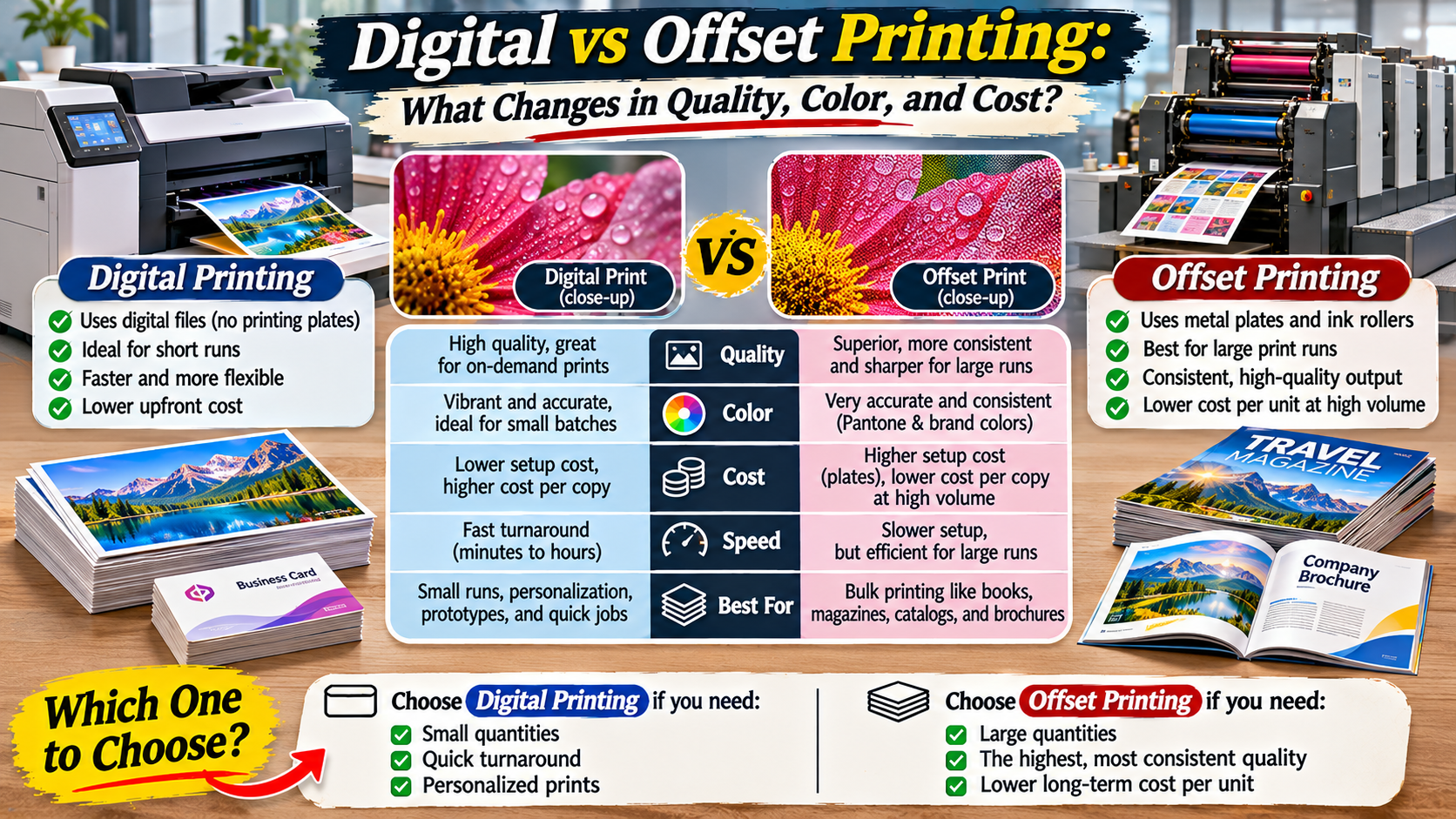
How does Print-on-Demand (POD) compare economically to traditional offset printing?
Traditional offset printing has high fixed setup costs (plates, press makeready) but very low unit costs ($2 – $3 per book on large runs of 2,000+ copies), requiring publishers to invest significant capital and manage physical warehouse storage. Digital Print-on-Demand (POD) prints single copies as orders arrive with zero upfront setup costs and zero warehouse fees, but carries a higher fixed unit cost ($5 – $8 per book), making it ideal for niche titles, self-publishers, and backlist preservation.
AM Halftoning vs FM Stochastic Screening: The Physics of Dot Placement
The conversion of continuous-tone photographic images into printable halftone dot patterns is governed by two fundamentally distinct screening mathematical architectures: Amplitude Modulated (AM) screening and Frequency Modulated (FM) stochastic screening.
In traditional AM screening, halftone dots are arranged in a rigid, fixed geometric grid (measured in lines per inch, LPI, typically 150 to 175 LPI for high-grade bookwork). Tonal gradations are created by varying the size (amplitude) of the dots: small dots create delicate highlights, while large overlapping dots create dense shadow tones. However, AM screening carries inherent risks of optical moiré patterns when printing fine textile patterns or screen-ruled textures.
FM stochastic screening, pioneered in digital pre-press, breaks through this physical limitation. In FM screening, all micro-dots are mathematically identical in size (typically 10 to 20 microns), but their frequency (distribution density) is randomized using complex blue-noise pseudo-random algorithms. Because there is no fixed grid or screen angle, FM screening completely eliminates moiré interference, renders photographic line details with continuous-tone smoothness, and drastically reduces ink consumption on press.
Digital Hard Proofing: Calibrated Contract Proofs and G7 Certification
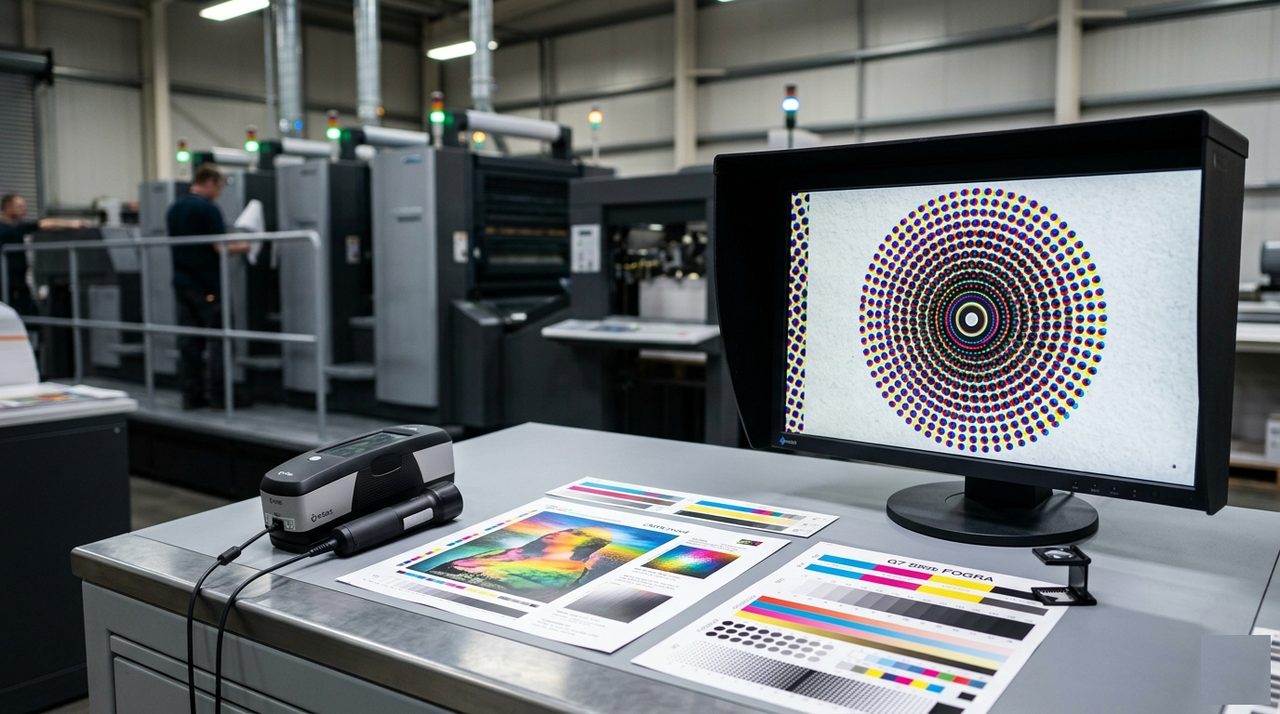
Before a publisher authorizes a $50,000 offset print run, the pre-press facility outputs a certified contract proof (often called an Epson or digital hard proof). A contract proof is a legally binding physical print that serves as the official color target for the pressman. High-end proofing systems utilize multi-channel pigment inkjet engines calibrated daily with spectrophotometers to match the exact target color space (such as GRACoL 2013 or Fogra51) within a strict color tolerance of Delta E (ΔE) < 1.5.
Modern pressrooms enforce the IDEAlliance G7 methodology, which aligns press color calibration to human gray balance perception rather than arbitrary mechanical dot gain curves. By ensuring that neutral gray scales remain perfectly balanced across highlight, mid-tone, and shadow ranges, G7 certification guarantees that books printed on different presses, at different facilities, or on different continents match with immaculate color consistency. Modern inline spectral cameras continuously scan running color bars at 15,000 impressions per hour, automatically micro-adjusting press fountain keys in real-time to preserve flawless tonal fidelity across multimillion-impression press runs.
Sustainable Pre-Press Chemistry and Processless Plates
In addition to optical precision, contemporary pre-press engineering has undergone a massive environmental overhaul. Historical film-based workflows produced gallons of toxic photochemical effluent containing silver halide complexes and heavy metal developers. Today’s processless aluminum litho plates eliminate chemical development tanks, acid rinses, and electrical drying units entirely. Once imaged by infrared diode lasers, the plate is mounted directly onto the press, where harmless fountain chemistry desensitizes the non-image areas during the first few waste impressions. This zero-effluent pre-press pipeline drastically lowers the carbon footprint of commercial book publishing while delivering unmatched micron-scale registration across four-color process layouts.