Once a book is printed and bound, it enters the global commercial ecosystem: the publishing business and distribution supply chain. A book may embody peerless editorial brilliance and award-winning typographic design, but if it lacks standardized trade identification, computerized retail metadata, copyright protections, and access to warehousing distribution channels, it remains practically invisible to booksellers, librarians, and the reading public.
The modern publishing business is an intricate web connecting content creators, publisher imprints, metadata registrars, national bibliographic agencies, wholesale distributors, independent booksellers, and digital global retailers. Understanding this commercial architecture is essential for any publisher navigating traditional offset warehousing runs or contemporary Print-On-Demand (POD) logistics.
The Bibliographical Passport: ISBNs, Barcodes, and ONIX Metadata
Commercial book commerce is powered by digital metadata protocols that feed global distribution pipelines:
Offset Warehousing Economics vs Print-on-Demand (POD) Logistics
A central economic strategic decision facing every publisher is the distribution model: traditional bulk offset printing versus digital Print-On-Demand (POD).
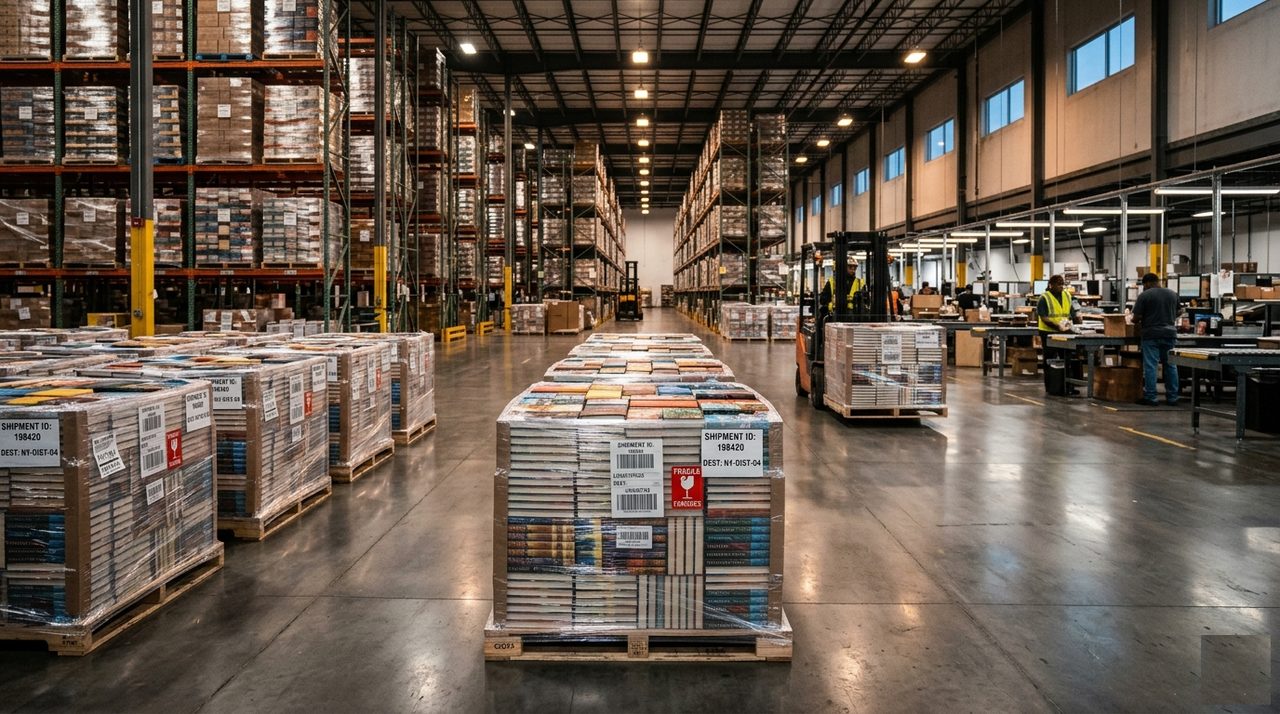
Traditional offset manufacturing involves significant upfront capital expenditure: plate burning, paper procurement, and press setup make small runs cost-prohibitive. However, as the print run scales from 2,000 to 20,000 copies, the unit manufacturing cost drops precipitously—often to less than $2.50 per hardcover. The publisher must then manage physical warehousing, palletized freight logistics, freight damages, and the historical publishing risk of bookseller returns (where unsold books can be returned for full credit). Conversely, digital Print-On-Demand (utilizing high-speed roll-fed digital toner and inkjet presses like HP Indigo or Canon ColorStream) manufactures books only after a customer places an order. While unit costs remain fixed and higher ($5 to $8 per unit), POD eliminates inventory carrying costs, capital risk, and warehouse obsolescence, revolutionizing backlist preservation and niche independent publishing.
Mathematical Cryptography of the ISBN-13 Check Digit
The International Standard Book Number (ISBN) is not an arbitrary sequence of numbers; it is a mathematically secure, self-verifying identification string governed by international standard ISO 2108. An ISBN-13 consists of five distinct structural elements: the GS1 bookland prefix (978 or 979), the registration group (country or language, e.g., ‘0’ and ‘1’ for English), the registrant (publisher prefix), the publication element (specific title/edition), and the final check digit.
The 13th digit is calculated using a Modulo 10 weighted checksum algorithm. Each of the first 12 digits is multiplied alternately by weights of 1 and 3: S = (d1×1) + (d2×3) + (d3×1) + (d4×3) + … + (d12×3). The checksum digit is then calculated as: Check Digit = (10 – (S mod 10)) mod 10. When a laser barcode scanner scans the EAN Bookland barcode at a retail cash register or distribution conveyor, the microchip instantly executes the Modulo 10 calculation. If a single digit is transposed or misread, the sum fails, preventing catastrophic point-of-sale inventory accounting errors.
Inventory Turnover Modeling: Economic Order Quantity (EOQ) in Offset Runs
Publishers navigate a fundamental financial optimization problem when establishing print runs: the Economic Order Quantity (EOQ) formula: EOQ = √((2 × D × S) / H), where D is annual customer demand, S is the fixed setup cost per print run (plates, press makeready, proofing), and H is the annual holding cost per book in warehouse storage. Larger offset print runs drastically lower unit production costs, but drastically increase capital lockup and warehouse storage fees. Production directors continuously balance EOQ models against digital Print-On-Demand break-even curves to maximize publisher cash flow.
Publishing Industry Governance, ISO Standards, and Legal Frameworks
The global trade and commercial distribution of books are governed by formal international regulatory standards that ensure seamless copyright protection, trade interoperability, and environmental compliance across borders. Key governing frameworks include:
In addition, modern publishers operate under strict consumer safety laws, including compliance with the Consumer Product Safety Improvement Act (CPSIA) for children’s books, which enforces stringent laboratory limits on heavy metals (lead) and phthalates in printing inks and casing varnishes.
Frequently Asked Questions on the Publishing Process
What is the distinction between developmental editing, copyediting, and proofreading?
Developmental editing focuses on the big picture: structural pacing, plot, voice, character arcs, and chapter organization. Copyediting occurs after the prose is structurally finalized, focusing on sentence mechanics, grammar, syntax, fact-checking, and adherence to style guides (like CMOS). Proofreading is the final visual quality check performed on typeset page proofs (galleys) to catch typographical errors, bad hyphenation breaks, widows, orphans, and layout glitches before printing.
Why is RGB to CMYK color conversion a critical pre-press concern?
Computer screens emit light using the additive RGB color model, which possesses a wide, vibrant color spectrum. Printing presses absorb light using subtractive CMYK ink layers, which have a significantly smaller color gamut. If RGB images are sent directly to press without calibrated ICC color profile conversion, bright neon tones—such as electric blues and vivid greens—will compress unpredictably, turning into dull, muddy shades on paper.
What is the difference between an ISBN and an ISSN?
An International Standard Book Number (ISBN) is a 13-digit identifier assigned to non-serial monographic publications (such as individual books, novels, textbooks, and anthologies). An International Standard Serial Number (ISSN) is an 8-digit identifier assigned to continuing serial publications, such as daily newspapers, academic journals, annual reports, and recurring magazines.
How does Print-on-Demand (POD) compare economically to traditional offset printing?
Traditional offset printing has high fixed setup costs (plates, press makeready) but very low unit costs ($2 – $3 per book on large runs of 2,000+ copies), requiring publishers to invest significant capital and manage physical warehouse storage. Digital Print-on-Demand (POD) prints single copies as orders arrive with zero upfront setup costs and zero warehouse fees, but carries a higher fixed unit cost ($5 – $8 per book), making it ideal for niche titles, self-publishers, and backlist preservation.
The Global Copyright Architecture: The Berne Convention and Fair Use
The commercial book publishing industry is legally anchored by the global intellectual property treaties that protect authorial rights across international borders. The foundational cornerstone of international copyright is the Berne Convention for the Protection of Literary and Artistic Works (originally established in 1886 and currently ratified by 181 sovereign nations under the administration of the World Intellectual Property Organization / WIPO).
Under the Berne Convention, three inviolable legal principles govern international publishing:
- Automatic Protection: Copyright protection exists automatically the moment a work is fixed in a tangible medium of expression (e.g., written on paper or saved to a digital hard drive). Formal government registration is not required to establish copyright ownership.
- National Treatment: Works originating in any signatory nation enjoy the exact same copyright protections and legal remedies in all other member states as those nations grant to their own domestic authors.
- Minimum Duration of Rights: The Berne Convention mandates a baseline copyright duration spanning the entire lifetime of the author plus a minimum of fifty years following their death (extended to life plus seventy years in the United States and European Union).
Wholesale Distribution Channels: Consignment, Discounting, and Returns
The commercial survival of physical book publishing depends upon wholesale distribution mechanics. Major distributors (such as Ingram Content Group, Baker & Taylor, and Gardners) act as central warehouses connecting thousands of publishers with physical bookstores, libraries, and online retailers.
The trade operates on a century-old commercial discount structure: publishers sell books to wholesalers and retail booksellers at wholesale trade discounts typically ranging from 40% to 55% off the list cover price. Furthermore, physical trade publishing operates under the unique historical legacy of returns (established during the Great Depression): bookstores can return unsold, undamaged copies to the publisher for 100% full credit or refund. Managing reserve-against-returns accounting and maintaining accurate inventory forecasting are essential fiscal disciplines required to maintain publishing house solvency.
The Rise of Hybrid Publishing Models and Global Digital Distribution
The 21st-century publishing landscape has expanded beyond the binary division of traditional corporate publishing and amateur self-publishing. Today, professional independent publishing and hybrid publishing models empower authors to retain their publishing rights while accessing professional editorial, design, and global distribution infrastructure.
Through integrated global digital networks, an independent publisher can upload print-ready PDF/X files and automated ONIX metadata feeds, making a book simultaneously available for order across 40,000 global booksellers, brick-and-mortar indie shops, and university libraries overnight. By eliminating the ruinous capital costs of speculative offset inventory warehousing, modern publishing distribution democratizes literary production, enabling diverse independent voices to thrive in the global marketplace of ideas. Automated micro-warehousing and localized print-on-demand nodes reduce international freight emissions while ensuring that cultural, scientific, and literary works remain permanently in print without fear of out-of-stock obsolescence.
Global Rights Management and Translation Licensing
Beyond domestic book sales, modern publishing houses generate substantial long-term revenues through the exploitation of subsidiary rights and international translation licensing. Literary agents and rights directors negotiate complex licensing contracts across foreign territories, negotiating language rights, audio adaptations, serialization, and cinematic options. Standardized contracts codified under the Frankfurt Book Fair and London Book Fair frameworks govern royalty accounting, territorial exclusivity, and currency exchange reconciliation. Managing subsidiary rights with contractual rigor allows publishers to maximize the cultural reach and commercial longevity of authorial intellectual property across international literary markets.